Researchers at the University of Colorado at Boulder have developed innovative optical microresonators that significantly enhance light circulation within microscopic chips. This breakthrough paves the way for advanced sensor technologies that could have wide-ranging applications, from navigation systems to chemical identification.
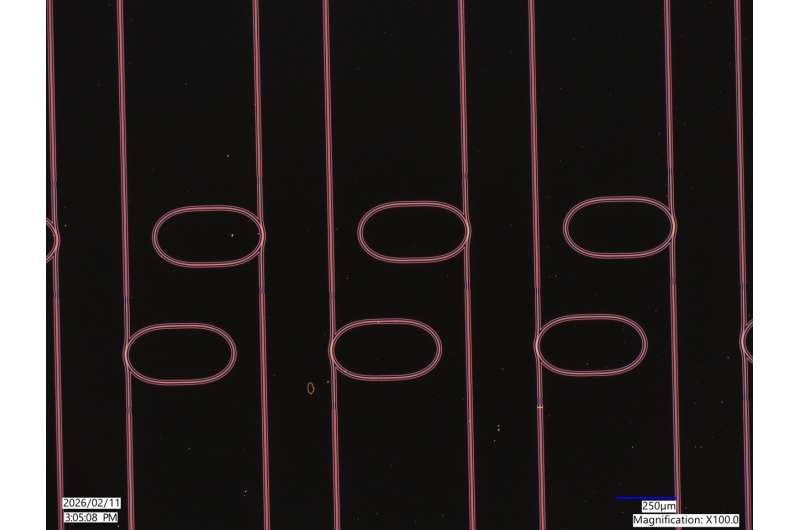
The team focused on creating what are known as “racetrack” resonators, so named for their elongated shape. These devices can trap light, allowing it to build in intensity. As Bright Lu, a doctoral student in electrical and computer engineering and lead author of the study, noted, “Our work is about using less optical power with these resonators for future uses.” The findings were published in the journal Applied Physics Letters.
Innovation in Design
The researchers employed a unique design utilizing “Euler curves,” which are smooth curves that facilitate light flow without sharp bends. Won Park, Sheppard Professor of Electrical Engineering and co-advisor on the study, explained, “These racetrack curves minimize bending loss.” This design innovation allows light to circulate longer, enhancing the interaction of photons within the device. High light intensities are crucial for effective operation, and minimizing loss is essential for achieving the desired performance levels.
The microresonators were fabricated using the Colorado Shared Instrumentation in Nanofabrication and Characterization (COSINC) clean room, which features an advanced electron beam lithography system. This facility provides the meticulous environment necessary for working at microscopic scales. Traditional lithography techniques limit resolution due to the wavelength of light used, whereas electron beam lithography allows for sub-nanometer precision, which is critical for the performance of the microresonators. Lu expressed enthusiasm about the fabrication process, stating, “Turning a thin film of glass into a working optical circuit is really satisfying.”
Challenges and Future Applications
One of the significant achievements of this research is the successful use of chalcogenides, a family of specialized semiconductor glasses. These materials are noted for their high transparency and nonlinearity, making them ideal for photonic applications. “Our work represents one of the best performing devices using chalcogenides, if not the best,” Park remarked. Although beneficial, processing chalcogenides poses challenges that require careful management.
After fabrication, the microresonators were tested under the supervision of James Erikson, a Ph.D. student specializing in laser-based measurements. He meticulously aligned lasers with microscopic waveguides to monitor light behavior within the device. The team focused on identifying resonance by analyzing data for “dips” in transmitted light, which indicate how well photons are trapped. “We want them to be deep and narrow, like a needle piercing through the signal background,” Erikson said, emphasizing the importance of the resonance shape as a quality indicator of the device.
The researchers identified that thermal effects significantly influence the device’s performance, especially when increasing laser power. “As a device heats up, its properties can change and cause it to work differently,” Erikson explained.
Looking ahead, the potential applications for these microresonators are vast. They could serve in compact microlasers, advanced chemical and biological sensors, and tools for quantum metrology and networking. Lu envisions a future where microresonators will integrate seamlessly with various photonic components, stating, “The goal is to build something you could hand to a manufacturer and create hundreds of thousands of them.”
This research not only exemplifies the University of Colorado at Boulder’s commitment to advancing technology but also highlights the incredible potential of microresonators in shaping the future of optical sensing and beyond.