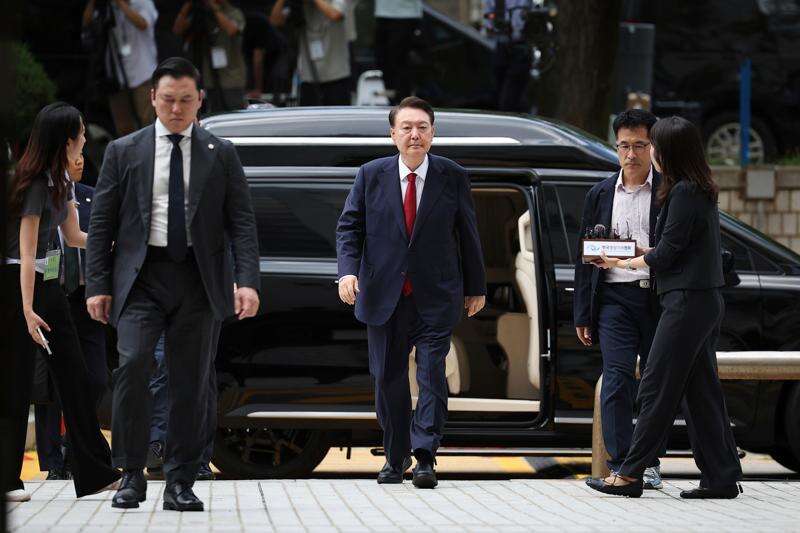
UPDATE: Former South Korean President Yoon Suk Yeol has been sentenced to life in prison for his controversial imposition of martial law in December 2024. This urgent ruling was delivered by Judge Jee Kui-youn, who found Yoon guilty of rebellion for his attempt to seize control of the National Assembly, marking a significant moment in South Korea’s democratic history.
The verdict comes as South Korea grapples with the ramifications of Yoon’s actions, which included mobilizing military and police forces in an illegal maneuver aimed at consolidating his power. Yoon’s brief decree lasted only six hours before it was lifted when lawmakers broke through military blockades to restore order. The court deemed his actions a direct threat to democracy, with a special prosecutor initially seeking the death penalty, although analysts widely anticipated a life sentence due to the lack of casualties.
As Yoon arrived at the Seoul Central Court, hundreds of police officers stood guard against a backdrop of intense emotional responses from supporters and critics alike. While Yoon’s supporters rallied outside, chanting for his release, critics demanded the harshest punishment available. The tension outside the courthouse underscored the deep divisions within South Korean society regarding Yoon’s leadership.
In a significant development, the court also convicted several former officials involved in the enforcement of Yoon’s martial law decree. Notably, ex-Defense Minister Kim Yong Hyun received a 30-year sentence for his pivotal role in planning the unlawful measure. Former Prime Minister Han Duck-soo was sentenced to 23 years for attempting to legitimize the decree. Both have indicated plans to appeal their sentences.
Yoon’s justification for the martial law was rooted in his assertion that it was necessary to combat “anti-state” forces obstructing his conservative agenda. However, the backlash from various political factions has been intense, culminating in Yoon’s impeachment on December 14, 2024, and his official removal from office by the Constitutional Court in April 2025. He has been under arrest since July 2025 and faces multiple criminal trials, with the rebellion charge carrying the most severe implications.
As the dust settles from this landmark ruling, the political landscape in South Korea remains fraught with uncertainty. The implications of Yoon’s actions and the court’s decisions are likely to resonate for years, influencing the future of governance in the nation.
What happens next? Yoon’s defense team has already indicated they will appeal the verdict, and the response from the public and political parties will be crucial in shaping the next chapter of South Korea’s tumultuous political saga. Stay tuned for updates as this story develops.