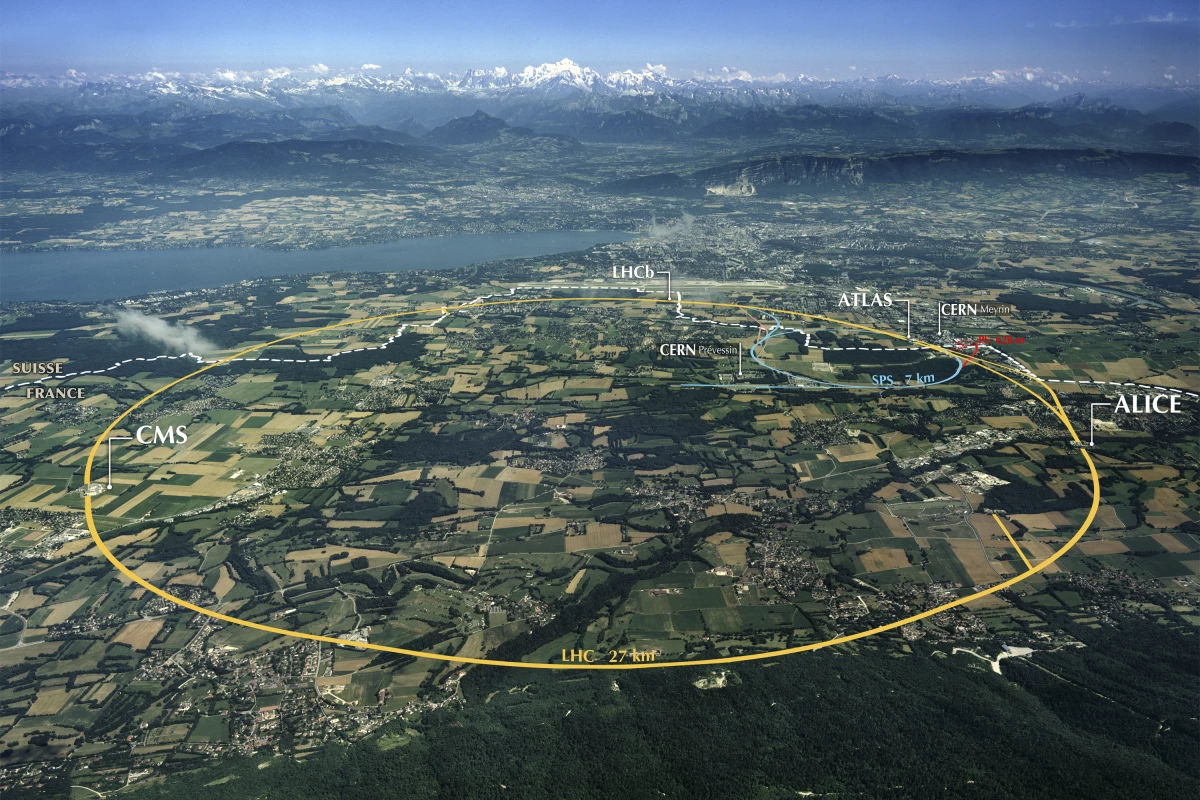
The Large Hadron Collider (LHC) at CERN has embarked on an innovative project to repurpose its waste heat, providing sustainable heating to several thousand homes in the Ferney-Voltaire area of France. This initiative not only enhances local energy efficiency but also demonstrates a commitment to reducing the environmental impact of one of the world’s largest particle accelerators.
With a circumference of 26.7 km (16.6 miles), the LHC is renowned for its groundbreaking discoveries, including the Higgs boson. However, it also consumes between 600 to 750 GWh of energy annually, generating significant waste heat in the process. Until recently, this excess heat was released into the atmosphere through cooling towers. Now, thanks to a partnership with local authorities, this waste heat is being redirected to benefit the community.
Innovative Heat Exchange System
The project involves the installation of a heat exchanger at the LHC’s Point 8 facility, which is situated near Ferney-Voltaire. According to Nicolas Bellegarde, CERN’s energy coordinator, the new system allows hot water from the LHC to flow through two 5-MW heat exchangers. This setup enables the transfer of thermal energy into a local district heating network, which serves both residential and commercial properties in the Zone d’Aménagement Concerté Ferney-Genève development area.
The system was officially inaugurated in December 2023 and is now fully operational. Bellegarde explained the transition: “Typically, hot water would pass through a cooling tower, releasing heat into the atmosphere. In our new setup, we capture that heat for local use.” This not only conserves energy but also contributes to the sustainability goals set by CERN.
Community and Environmental Impact
By utilizing waste heat from the LHC, CERN is taking significant steps toward minimizing its carbon footprint while simultaneously providing a valuable resource to the local community. The project not only enhances the energy efficiency of the facility but also supports the region’s heating needs, demonstrating a model of how scientific institutions can engage with and benefit their surrounding areas.
The move has been well-received, as it showcases how cutting-edge technology can intersect with community welfare. This initiative serves as an example for other scientific organizations to consider similar sustainable practices, aligning technological advancement with environmental responsibility.
As the LHC continues its groundbreaking research, its ability to contribute positively to the local community through this innovative heating system exemplifies a forward-thinking approach to science and sustainability.