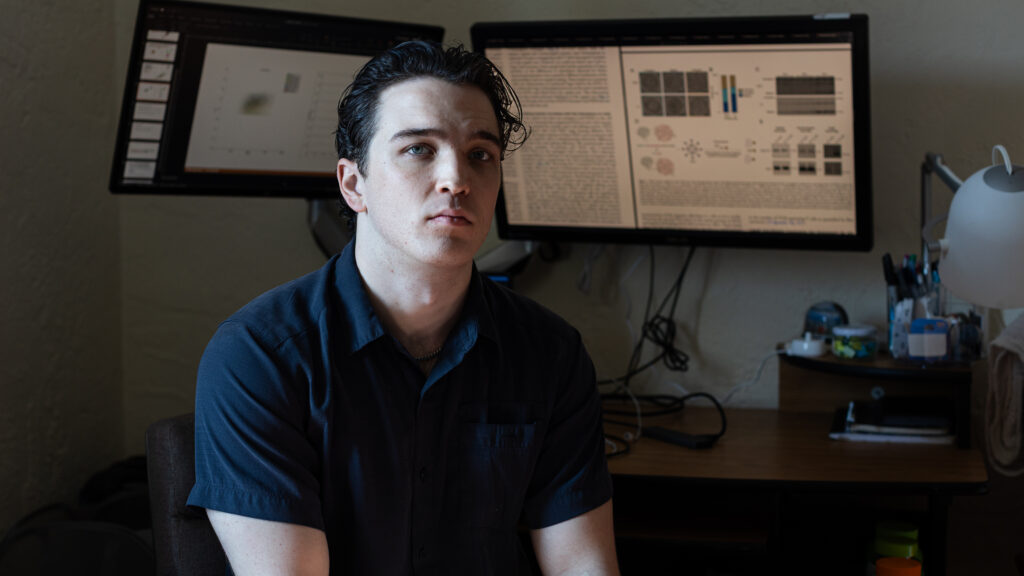
First-year biomedical Ph.D. students across the United States are facing significant challenges due to a precarious funding environment. Many aspiring scientists, including students like Alex Sathler, are struggling to secure positions in research labs, despite having received prestigious fellowships. Sathler, who was awarded a $37,000 annual stipend from the National Science Foundation (NSF) as part of its Graduate Research Fellowship Program, found himself rejected by multiple labs due to funding shortages.
As competition for lab positions intensifies, students report that professors are increasingly hesitant to take on new trainees. The National Institutes of Health (NIH) has funded fewer projects in recent years, with projections indicating continued reductions. This shift has led to a scarcity of opportunities in well-funded labs, leaving Sathler and his peers disheartened. “The real sense that I get is that there aren’t enough labs with funding to give everyone their best fit,” Sathler stated.
This funding crisis is not isolated to Sathler’s experience. Numerous first-year biomedical graduate students nationwide have shared similar stories, expressing frustration at having their hopes dashed after initial agreements with faculty members fell through. “The strain that you’re hearing is real. It’s not an isolated case. It’s actually across the board,” said Chevelle Newsome, president of the Council of Graduate Schools. This organization represents more than 450 member universities.
Changing Admission Processes and Rising Anxiety
The current climate has forced some institutions to rethink their admissions processes. For instance, Georgia Tech and Emory University have shifted to a direct-admission model for their joint bioengineering program, requiring applicants to secure a lab placement before being offered admission. This change has raised concerns about students relying solely on conversations with lab members instead of firsthand experiences to choose where to pursue their research.
At Stanford University, another top-tier institution, changes have also been implemented. The university has reduced the independent funding for bioscience graduate students from four years to two. As the financial landscape evolves, prospective advisors are becoming more selective, with Joe Wu, director of the Stanford Cardiovascular Institute, noting that faculty are now less willing to commit unless students demonstrate exceptional potential.
Students like Hannah Barsouk, a biochemistry student at Stanford, have experienced the anxiety these changes create. Barsouk reported that many labs expressed uncertainty about their ability to accept new students due to funding issues. “Funding issues have cast a cloud of general anxiety over my first year,” she remarked, noting that she has reached out to as many as 40 labs without receiving clear commitments.
The Long-Term Impact on Academic Careers
This funding crisis not only influences immediate lab placements but also raises questions about the long-term career trajectories of these budding scientists. Many students are reconsidering their aspirations in academia as they grapple with the reality of a competitive job market where funding is increasingly difficult to secure. One biology student recounted how an initial commitment from a professor for a lab space changed dramatically when funding cuts affected the program.
Despite the challenges, students like Sathler still hold out hope. They have until they enter their second year to finalize their lab placements, and there are glimmers of optimism as congressional appropriations committees have tentatively endorsed slight budget increases for the NIH. However, the broader instability in federal funding creates a lingering sense of uncertainty about the future of scientific research in the United States.
In the face of these challenges, students are left to ponder their futures. “I still very much want to be a professor, and I just don’t know if that’s ever going to be possible because of the way NIH and the NSF are being dismantled,” one anonymous student lamented. As these future leaders in science navigate their critical early years, the impact of funding decisions at the federal level continues to shape their academic journeys.
The coverage of the federal government’s role in shaping the biomedical workforce is supported by a grant from the Dana Foundation and the Boston Foundation, though these financial backers do not influence editorial decisions.