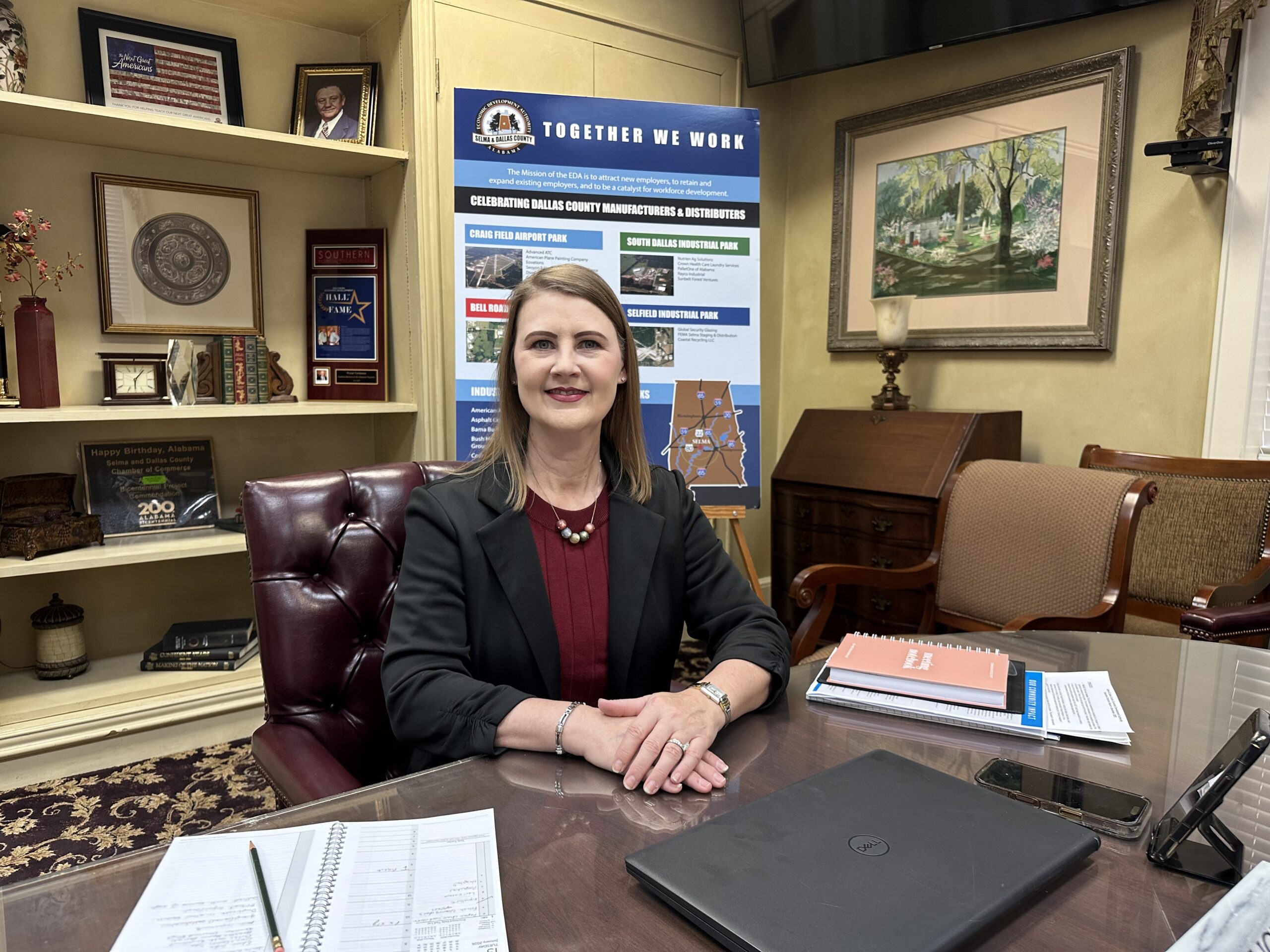
Brenda Tuck has officially taken on the role of executive director of the Selma and Dallas County Economic Development Authority, marking a significant return to her roots in January 2025. Tuck, who has over 20 years of experience in economic development across various levels, succeeds M. Wayne Vardaman, who retired after 24 years of dedicated service.
Vardaman expressed confidence in Tuck’s capabilities, stating, “I have worked with her in numerous roles over the past 30 years, and she’s very capable of leading the EDA into the future.” He commended her broad and diverse knowledge in economic development, which he sees as invaluable for the authority’s future.
Tuck’s journey in economic development began in Selma, where she expressed pride in returning to the community that shaped her career. “It has been an honor and a privilege to work with Wayne Vardaman,” she reflected. “The accomplishments he has achieved for this county are evident with the numerous announcements for jobs and investment throughout the county.”
Originally from Limestone County, Tuck moved to Selma in 1995 and spent 17 years there before pursuing opportunities elsewhere. Her early career included roles in nonprofit management and marketing, which would later inform her approach to economic development. She initially worked with the American Cancer Society in Selma, coordinating support across an eight-county region. After the Selma office consolidated, she joined American Candy Company in a marketing capacity, where she learned the harsh realities of corporate closures.
In January 2000, Tuck transitioned to economic development with Pioneer Electric Cooperative, where she worked alongside George Alford Jr.. His mentorship helped her navigate negotiations, contracts, and the challenges facing local entrepreneurs. Tuck recalls, “He taught me everything he knew… I have been very fortunate and blessed to work with legends in the industry of economic development.”
In 2005, Tuck and Alford established Alford and Associates LLC, expanding their economic development efforts. Tuck later became the executive director of the Marengo County Economic Development Authority before joining the Alabama Department of Commerce in 2016. In 2019, she was appointed the state’s first rural development manager, where she collaborated with 44 rural counties, enhancing her understanding of regional economic dynamics.
As Tuck prepares to lead the Selma and Dallas County EDA, she has outlined priorities that focus on existing industries. She emphasized the importance of nurturing the current industrial base, stating, “We’ve got to take care of what we have.” Tuck plans to build on Vardaman’s legacy while also focusing on recruiting companies that complement the county’s strengths.
A critical aspect of her strategy will be addressing the shortage of available “product,” a term used in economic development to denote ready-to-use industrial sites and buildings. Tuck acknowledged that communities across Alabama, including Dallas County, face challenges in this area. “We’re going to collaborate—with utilities, rail partners, and state resources—to bring in what’s needed to make these sites competitive,” she said.
Perception also poses a challenge for Dallas County, which Tuck believes can be transformed into an opportunity. “There’s this idea that there’s nothing there,” she noted. By highlighting the number of industries and industrial parks, Tuck aims to reshape the narrative. “If we’re not telling our best story, nobody’s telling our best story,” she added.
Tuck identifies Dallas County’s people and its industrial diversity as significant strengths. She recalls conversations with former colleagues who regard Selma for its strong sense of community. The presence of four industrial parks and a local community college further supports workforce development and long-term growth.
Her academic credentials include an associate’s degree from Wallace Community College Selma, a bachelor’s degree in business administration from Faulkner University, and a master’s degree in international relations earned through the Prince Khaled Fellowship at Auburn University Montgomery.
Transitioning from a statewide role to local leadership, Tuck is eager to engage directly with the community. “To be able to jump in again and be effective on the ground in the community, just that hands-on aspect, that’s what I’m looking forward to the most,” she said.
As Tuck embarks on this new chapter, her extensive background and commitment to collaboration suggest a promising future for the Selma and Dallas County Economic Development Authority.