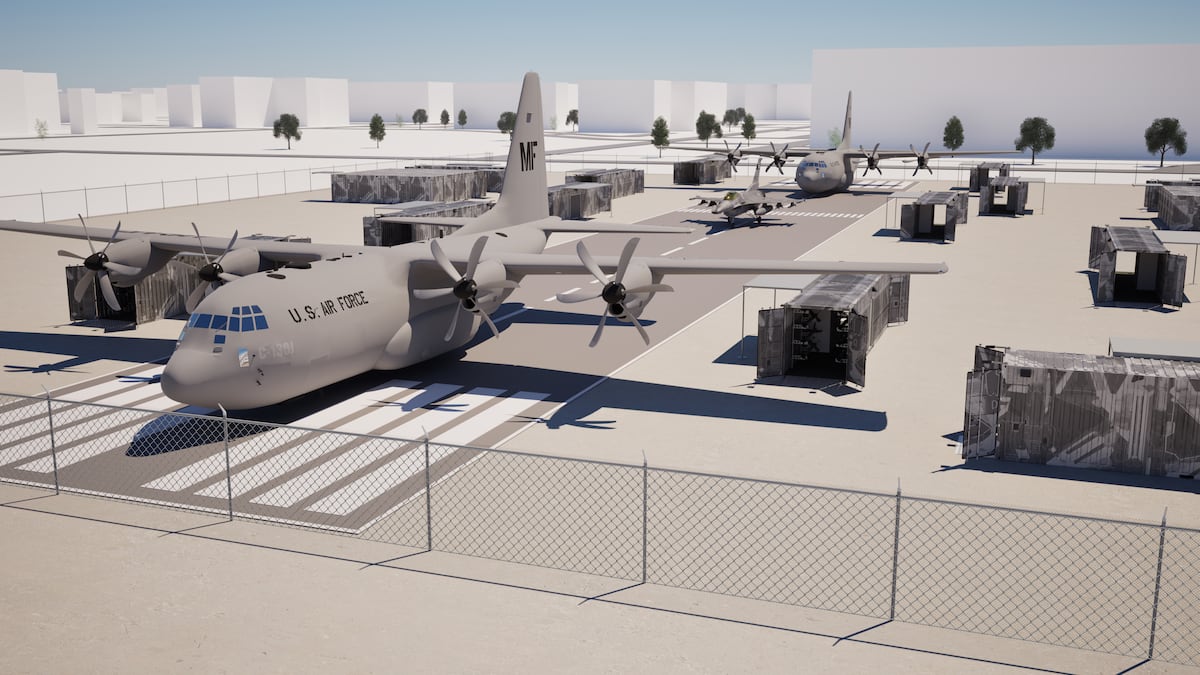
The U.S. Air Force is advancing its Basic Military Training (BMT) by introducing two realistic training ranges designed to enhance airman preparedness. These ranges, equipped with mock runways and real aircraft, will be constructed at select bases, with a focus on creating an immersive environment that fosters a strong sense of mission among trainees. According to Maj. Gen. Wolfe Davidson, Commander of the Second Air Force, this initiative aims to instill an “Airmindedness” attitude in each airman, aligning their training more closely with the force’s operational goals.
By transitioning training from traditional drill pads to simulated airfields, the Air Force seeks to provide trainees with immediate, hands-on experience relevant to their roles in generating airpower. “By progressing training from the drill pad to a simulated airfield, we give trainees immediate, hands-on context for their role in generating airpower,” Davidson stated in an interview with Military Times.
Transforming Basic Military Training
This initiative is part of a broader overhaul known as BMT Next, which began with BMT 2.0 in October 2022. The initial phase emphasized physical fitness, while the current BMT 3.0 introduces these new training ranges. The modifications aim to better prepare airmen for real-world scenarios, enabling them to discover their core identity through shared operational experiences before they commence specialized technical training.
Davidson highlighted that the transformation enables trainees to connect their identities more closely with the Air Force mission to fly, fight, and win. This approach acclimatizes them to the expectations they will face when supporting an Air Expeditionary Wing, the core operational unit of the Air Force.
Trainees will now be required to demonstrate physical readiness, teamwork, accountability, and a warrior ethos—key competencies essential for military success. Instead of focusing solely on individual tasks, they will learn how their actions contribute to the broader mission in contested environments.
Details on the Training Ranges
The first training range will be established at Joint Base San Antonio-Lackland, utilizing an existing physical training pad to minimize disruptions in training. Davidson noted that this partnership with the 502d Air Base Wing has accelerated the project timeline, reflecting the urgency and enthusiasm surrounding the initiative. Initially, the range will exceed the size of a football field, with plans to triple its dimensions in the future.
The BMT Next initiative will proceed in phases, starting with mobile, containerized training stations. Subsequently, a dedicated expeditionary airfield will be built at the Pacer Forge site, simulating a forward-deployed environment. The second training range, known as the Forward Air Base Training Range, will also be located at the Pacer Forge site.
This new training regimen follows a “Crawl, Walk, Run” progression, where foundational lessons serve as the “crawl” phase. The initial range training represents the “walk,” enabling trainees to practice skills in a controlled setting before applying them in a multi-day validation exercise during the “run” phase at Pacer Forge.
The final, permanent Air Base Training Range at JBSA-Lackland is projected to feature four mock concrete runways, allowing for simultaneous training of multiple groups. This larger facility will also include 16 containerized training stations dedicated to various airfield tasks, such as arming aircraft and cargo loading.
Davidson confirmed that historic aircraft, including an F-16 Fighting Falcon and C-130 Hercules, will be part of the training ranges, providing authentic hardware for trainees to work with. The first training device on the Air Base Training Range is expected to be operational by April 2026, with the initial expeditionary airfield at the Pacer Forge site ready for training by October 2026.
This comprehensive $30 million investment is distributed across the budgets for fiscal years 2025 and 2026. The long-term goal is to establish a permanent training facility, with projected costs ranging from $50 to $75 million, pending approval in future budget proposals.
Davidson emphasized the importance of this transformation, stating, “This entire effort is a direct investment in the readiness and lethality of our force. We are creating the foundational ‘Airmindedness’ and warrior ethos in our newest Airmen to ensure we remain the world’s most capable Air Force.”