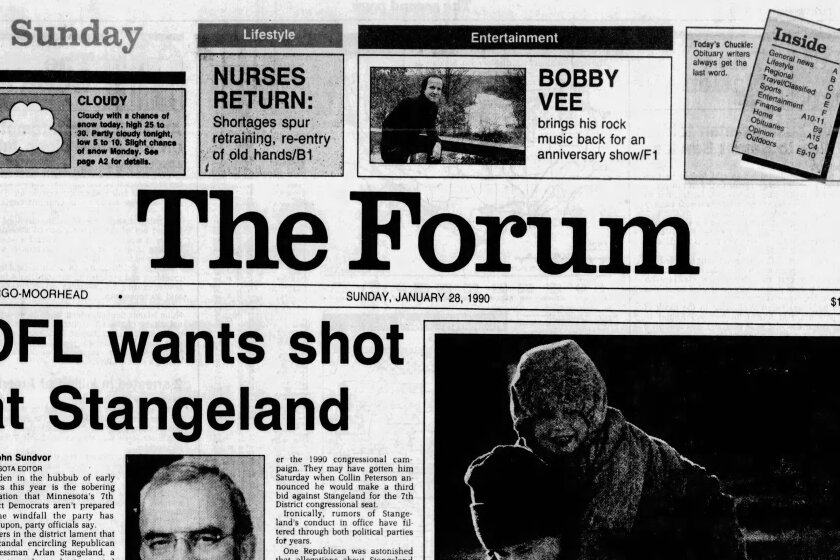
On March 15, 1990, The Forum reported on a notable trend in Fargo, North Dakota, where experienced nurses were returning to the workforce. In response to a nationwide nursing shortage, many of these professionals were enrolling in refresher courses designed to update their skills and familiarize them with advancements in medical technology.
Gracia Fulwiler, the program coordinator for the refresher course at St. Luke’s Hospitals, observed the initial reactions of participants. “The looks on their faces are ones of bewilderment, and they’re overwhelmed,” she noted. These nurses, who had left the profession for various reasons, were contemplating a return to the field. The three-week course aimed to equip them with the skills necessary to navigate contemporary nursing practices confidently.
The course, originally offered by St. Luke’s School of Nursing, was discontinued when the school closed. However, the ongoing demand for the program prompted the hospital to revive it three years ago. The first class graduated 24 nurses, followed by 23 the next year and 28 in the most recent class. While the upcoming course in March 1990 will cater specifically to registered nurses (RNs), Fulwiler expressed hope for future sessions that include licensed practical nurses (LPNs) as well.
The fee for the course is $350, and all participants thus far have been women, with an average absence from nursing of 12 to 15 years. Some, like one individual who had been out of the profession for 25 years, initially left to focus on family. Fulwiler explained, “A lot has gone on over the past years, and most of them don’t feel they can make it because it’s changed too much.” Yet, as they progress through the course, their confidence begins to return.
Participants complete 40 hours of classroom instruction and 80 hours of clinical practice, assisting with patient care. Fulwiler reassured that “basic nursing, at the bedside, hasn’t changed a lot,” though the technological advancements have been significant. “Look at the way we take temperatures,” she said, highlighting the evolution from mercury thermometers to modern digital devices.
The primary goal of the refresher course is to draw former nurses back into the profession and to bolster the nursing staff at St. Luke’s. Most participants reside within a 45-mile radius of Fargo-Moorhead, although one student traveled from Langdon, North Dakota, 180 miles away, to attend. Fulwiler expressed pride in seeing former nurses return to the field, stating, “It feels good to put someone back in circulation.”
Among those revitalizing their nursing careers is Carolyn Haugen, who shared her experiences after an eight-year hiatus. Haugen, now in her 50s, returned to nursing due to financial pressures from her family’s farming business. “If it rains, maybe I’ll quit,” she joked, reflecting on the challenges of farm income fluctuations.
Having been a registered nurse since 1959, Haugen’s commitment to the profession has remained steadfast. “I decided to be a nurse when I was in the fourth grade, and I’ve never changed my mind,” she recalled. Despite the demands of motherhood and her initial decision to leave nursing, she re-entered the workforce in 1981 after completing a refresher course at St. Luke’s.
Haugen described the transition back to nursing as a shock, especially regarding the technological advancements in patient care. “I was amazed, flabbergasted!” she remarked, noting the integration of equipment such as IV pumps and patient-controlled analgesia devices, which were absent during her earlier career.
The pace of work in modern nursing has also intensified. “They move at such a pace here,” she noted, emphasizing the physical and mental demands of the job. Despite the challenges, Haugen expressed satisfaction in her work, stating, “I get a lot of satisfaction out of this.”
She acknowledged that while nursing is often portrayed glamorously on television, the reality involves hard work and extensive paperwork. “Nursing isn’t a glamorous profession,” Haugen remarked. As the industry continues to evolve, she sees improvements in compensation and benefits, noting that hospitals must remain competitive to attract and retain nurses.
With her family settled in Fargo and her son managing their farm, Haugen has found fulfillment in her nursing career. She considers the possibility of engaging in volunteer work in the future, but for now, her commitment to nursing remains strong, contingent on the agricultural conditions.
The initiative to bring former nurses back into the field through refresher courses not only addresses the pressing nursing shortage but also revitalizes the passion of experienced professionals like Haugen. As healthcare continues to change, the dedication of these returning nurses is critical in maintaining quality patient care.