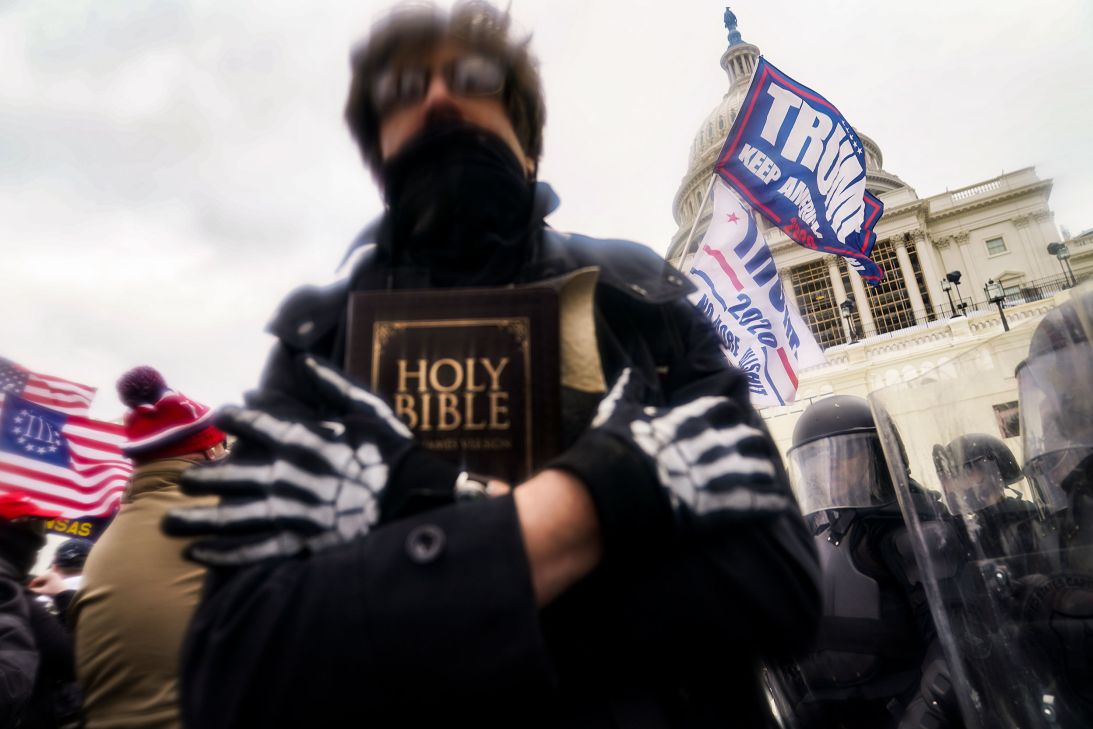
The concept of White Christian nationalism has sparked intense debate across the United States, particularly following the events of January 6, 2021, when supporters of former President Donald Trump stormed the Capitol. This ideology, characterized by a belief that the nation should be governed according to Christian principles, draws upon historical precedents that extend far beyond contemporary politics.
Historian Kelly J. Baker asserts that the roots of White Christian nationalism can be traced back to movements such as the Ku Klux Klan, which emerged in the early 20th century. Founded by William J. Simmons in 1915, this organization gained over 5 million members by 1920, promoting a vision of America as a dominantly White, Protestant nation. Simmons believed that the influx of non-White immigrants threatened the nation’s Christian heritage, a sentiment that resonates with many modern-day White Christian nationalists.
According to Baker, the Klan’s ideology revolved around a racial hierarchy where White Protestant Christians were deemed superior. “They only wanted a nation for White Christians,” she explains, highlighting how such beliefs laid the groundwork for the current discourse around White Christian nationalism. This ideology has since evolved but remains influential, especially among certain political groups in contemporary America.
The term “White Christian nationalism” gained widespread recognition after the Capitol insurrection, where many participants displayed Christian symbols alongside images of Trump. Critics argue that the ideology promotes a distorted version of Christianity that aligns with a specific political agenda, while some defenders assert that it represents a legitimate expression of faith in the public sphere.
One common misconception is that White Christian nationalism is a recent phenomenon. In reality, it has existed throughout American history, often resurfacing during periods of social upheaval. Historical figures such as Abraham Lincoln faced similar challenges, as ministers during the Civil War sought to declare the United States a Christian nation, despite the Constitution’s secular foundation.
Many Americans remain unaware of the complexities surrounding White Christian nationalism. A survey conducted by the Public Religion Research Institute in March 2024 revealed that 54% of US adults had heard little to nothing about the ideology. This lack of awareness often leads to oversimplified narratives that overlook the movement’s diverse adherents, who can span across political affiliations and ethnic backgrounds.
Some proponents of White Christian nationalism, like Douglas Wilson, argue that the United States was founded as a Christian nation. They contend that historical immigration patterns have altered the nation’s character, calling for a return to a more homogenous society. Critics counter this view by referencing the Founding Fathers’ intent to create a secular government, emphasizing that the nation’s diversity is a strength rather than a weakness.
Despite its controversial nature, White Christian nationalists advocate for policies that align with their beliefs, including the promotion of laws based on biblical principles. Their vision often includes a rejection of same-sex marriage and a rollback of women’s rights, with some asserting that the 19th Amendment, which granted women the right to vote, should be repealed.
The historical context of White Christian nationalism cannot be ignored. Its earlier iterations justified the displacement of Native Americans, slavery, and racial segregation. For many scholars, the ideology is intertwined with a “religion of Whiteness,” which seeks to maintain the dominance of White identities in America.
Many within the movement today reject the violent legacy of groups like the KKK, asserting that modern White Christian nationalism does not promote racial violence. However, they still share the underlying goal of establishing a nation reflective of their interpretation of Christian values. Baker notes that this desire for a “homogenous, White, Protestant nation” continues to resonate among certain segments of the population.
Furthermore, the rise of White Christian nationalism has political ramifications. During the Cold War, fears of “Godless communism” prompted some politicians to call for a constitutional amendment recognizing the US as a Christian nation. This political history illustrates how intertwined religious beliefs and national identity can become.
The question remains: what type of Christianity do proponents of this ideology envision for America’s future? The early colonies were marked by a plethora of religious beliefs, making it difficult to define a singular Christian identity. The Founding Fathers consciously separated church and state to avoid the religious conflicts that plagued Europe.
As the debate continues, many Americans are left grappling with the implications of White Christian nationalism. Some scholars argue that it poses a threat to the principles of democracy by promoting an exclusionary definition of “we the people.” Philip Gorski, a historian, has warned that the ideology fundamentally conflicts with the nation’s democratic values, which celebrate diversity and inclusion.
The enduring appeal of White Christian nationalism highlights a significant tension within American society. While many advocate for a vision of a diverse and inclusive nation, others cling to a historical narrative that prioritizes a specific interpretation of Christianity. As these discussions unfold, the implications for American democracy and societal cohesion remain profoundly significant.