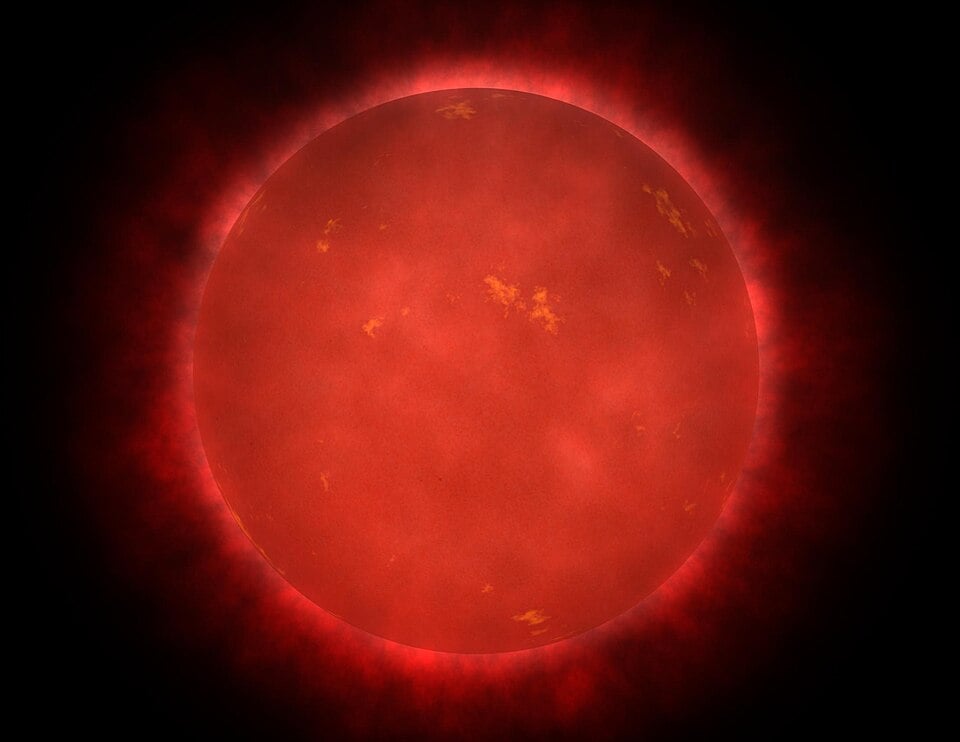
Recent research has revealed significant insights into the origins of carbon and oxygen, essential elements for life, by studying the spectra of nearby stars. Led by astronomer Darío González Picos from Leiden University in the Netherlands, the study examined high-resolution data from 32 M dwarf-type stars. These stars, prevalent in our galaxy, offer clues about the stellar processes that create and disperse elements throughout the cosmos.
The research team focused on detecting rare isotopes of carbon and oxygen, which serve as indicators of a star’s chemical evolution. The isotopes are variations of elements distinguished by the number of neutrons in their nuclei. On Earth, for instance, 99% of carbon consists of atoms with six neutrons, while a smaller portion contains seven. By analyzing the chemical fingerprints left in the light emitted by these stars, the researchers were able to gain insights into the processes that formed these elements.
Unveiling Stellar Chemistry
The team utilized archives from the Canada France Hawai’i Telescope, filtering through data that comprised stars with effective temperatures ranging from 3,000 to 3,900 Kelvin. These stars exhibited strong signals for heavier elements, indicating significant metallicity in their atmospheres. The findings confirm earlier predictions regarding galactic chemical evolution, suggesting that stars with less chemical enrichment than the Sun possess fewer minor isotopes.
“We now see that stars that are less chemically enriched than the Sun have fewer of these minor isotopes,” stated Sam de Regt, a member of the research team. This discovery provides a new method for scientists to trace the chemical history of the universe, offering a timeline of element creation and distribution.
The original intent of the high-resolution spectra was to search for exoplanets, but González Picos proposed using the data for isotope research, leading to these significant findings. “The observations were originally made for a completely different reason than the one we are using them for now,” said Ignas Snellen, another collaborator on the project. “It was entirely Darío’s idea to use the high-resolution spectra for this isotope research – with impressive results.”
The Significance of Stellar Nucleosynthesis
Understanding how carbon and oxygen are formed in stars is crucial, as these elements are fundamental to life on Earth. Our planet’s biological systems are carbon-based, and we rely on oxygen produced by living organisms. The process by which stars create these elements is known as stellar nucleosynthesis, a complex series of nuclear fusion reactions that transform lighter elements into heavier ones.
For example, our Sun currently fuses hydrogen into helium and will continue to do so for several billion more years. Eventually, it will exhaust its hydrogen supply and begin fusing helium into heavier elements, including isotopes of carbon and oxygen. At that stage, the Sun will evolve into a red giant, expelling its materials into space, contributing to the cosmic cycle of element formation.
Stars more massive than the Sun undergo similar processes but can produce even heavier elements during supernova explosions, enriching their surrounding galaxies with materials necessary for forming new stars and planets. As stated by González Picos, “This cosmic detective story is ultimately about our own origins, helping us to understand our place in the long chain of astrophysical events, and why our world looks the way it does.”
The ongoing research emphasizes the role of stars in a vast cosmic recycling project, where the light they emit carries the history of their evolution, encapsulated in the chemical compositions they produce. As astronomers continue to explore the chemical fingerprints of stars, our understanding of the universe’s origins and our existence within it becomes clearer. The work of González Picos and his team marks a pivotal step in deepening our comprehension of stellar chemistry and its implications for life on Earth.