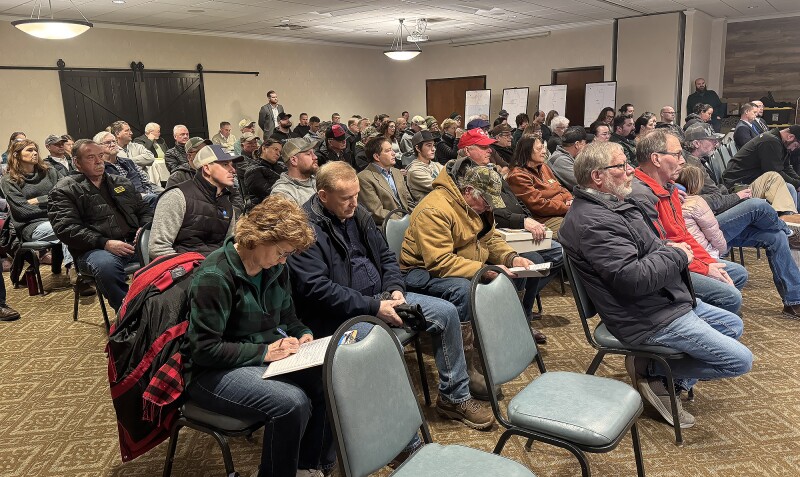
Land and property owners expressed significant concerns regarding the proposed JETx project during a public hearing hosted by the North Dakota Public Service Commission on January 16, 2026. Attendees raised issues about potential environmental and health impacts, the reduction of property values, the adequacy of the public input process, and a recent state law allowing the commission to override local zoning ordinances.
Approximately 100 individuals participated in this hearing, which took place at the Baymont by Wyndham Jamestown Conference Center & Water Park. This meeting was the last of three hearings, following similar events held in Edgeley and Ellendale earlier in the week. The hearings aimed to gather public feedback for the PSC’s official record as it evaluates the transmission line project.
The PSC will consider whether the project will have minimal adverse effects on the environment and local residents. Key factors include the project’s compatibility with environmental preservation, efficient resource use, and the minimization of negative human and environmental impacts while ensuring reliable energy delivery.
Proposed by the Midcontinent Independent System Operators (MISO), the JETx project has been touted as a means to enhance regional power grid reliability across a 15-state area and parts of Manitoba. The estimated cost of the project, which includes substation expansions in Jamestown and Ellendale, is approximately $406 million.
The JETx project involves constructing about 92 miles of a new double circuit 345 kilovolt transmission line from Otter Tail Power Co.’s existing substation, located about 5.5 miles north of Jamestown, to Montana-Dakota Utility’s substation, approximately 1 mile west of Ellendale. According to Jason Weiers, manager of transmission policy and contracts at Otter Tail Power, the project aims to create a 345 KV transmission loop that connects two existing systems, thereby improving energy delivery reliability throughout North Dakota and the broader Midwest.
Weiers noted that initial construction will involve one circuit, with approximately 3% of the overall project route double-circuited to minimize impacts. Support for the project has also been voiced by Dan Inman, senior vice president of power delivery at Minnkota Power Cooperative, who highlighted its benefits for residents and utilities alike. He emphasized that the project would enhance the resilience and cost-effectiveness of the power system.
Concerns were raised regarding House Bill 1258, which grants the PSC the authority to override local zoning ordinances that conflict with state approval for electric transmission projects. Local townships have established setback distances of 2,640 feet—half a mile—between any occupied dwelling and high-voltage transmission lines. In contrast, the PSC currently has a standard setback of 500 feet.
During the hearing, Levi Taylor, a member of the Stutsman County Commission, represented his views on the project’s compliance with local regulations. He noted that the methodology for the county’s 1,000-foot setback was based on specific calculations related to pole height. Concerns were raised about the applicants not requesting a conditional use permit from the county, which might be attributed to the timing of local ordinance adoption relative to the project’s submission to the PSC.
“It is taking away land that has been in families for generations, and even more importantly, the promise of generations to come,”
stated Alana Wagner, representing her family from rural Edgeley. She highlighted the potential loss of private property due to the project without sufficient evidence of its necessity.
Many residents expressed dissatisfaction with the outreach efforts made by project developers. Steve Schwarzrock, a local resident, mentioned that he had not received adequate communication regarding the project’s implications for his property, which is situated approximately 830 feet from the proposed route.
Weiers defended the outreach program, stating that it was designed to educate stakeholders and facilitate feedback. He mentioned that project applicants had sent letters to counties and townships in March and September 2023, soliciting input on the transmission line route.
The PSC will proceed by discussing the case with its advisory staff, drafting an order based on these discussions, and ultimately presenting the matter for a final decision at a formal meeting. Construction of the JETx project is expected to begin in the third quarter of 2026, with completion and energization anticipated by late 2028.
As the project moves forward, the ongoing dialogue between project developers, local residents, and regulatory bodies remains critical in addressing the diverse concerns surrounding the JETx initiative.