Federal courts recently ruled in favor of offshore wind developers in the northeastern United States, providing a temporary reprieve amid ongoing challenges from the Trump administration. The administration has opposed offshore wind projects, labeling them as potential threats to national security and ecological systems. However, recent court decisions have allowed projects such as Revolution Wind, based in New London, to continue their development despite the administration’s efforts to halt their progress.
The Trump administration’s latest actions include a stop-work order, which was contested in court and ultimately reversed for the time being by Revolution Wind, Empire Wind, and Coastal Virginia Offshore Wind. The administration claims that a classified Pentagon report has identified offshore turbines as a national security threat. This assertion has raised eyebrows among lawmakers and industry advocates, who express skepticism regarding the Pentagon’s silence on the specifics of the alleged threat.
Concerns have been voiced that the large rotating blades of wind turbines may interfere with military radar systems, creating a phenomenon known as radar clutter. Industry supporters argue that any issues related to radar interference had previously been addressed and mitigated. The U.S. Department of Interior, which manages offshore energy leases, has stated that it has consulted with various military agencies throughout the planning process and has continuously worked to resolve any raised concerns.
In fact, developers of Revolution Wind reportedly invested tens of thousands of dollars on software solutions to alleviate radar issues for the U.S. Air Force. A letter from the Department of Defense in the following year affirmed that the wind project “would not have adverse impacts to DoD missions in the area,” further complicating the Pentagon’s current stance.
Despite the potential economic benefits of these projects, the Pentagon has not provided clarity on its latest national security concerns. U.S. Representative Joe Courtney, a member of the House Armed Services Committee, has sought information from the Pentagon but received a polite refusal. Courtney has expressed frustration at the lack of communication, particularly given the Pentagon’s obligation to inform Congress on matters of national security.
On March 15, 2024, four senior House Democrats, including Courtney, sent a letter to both the Defense Department and the Interior Department, requesting briefings on the security risks associated with offshore wind. Courtney criticized the Pentagon’s response, which redirected concerns to the Department of the Interior, saying, “This is crazy if it is a national security issue.”
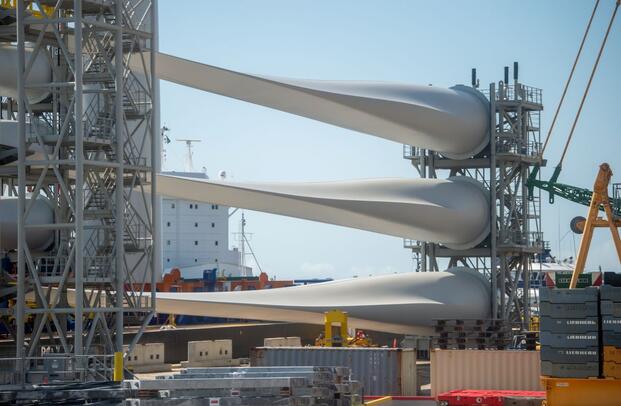
The stakes are high for the future of the offshore wind industry in the Northeast, particularly for communities like New London, which is experiencing revitalization thanks to investments in wind projects. Norwegian energy company Orsted, the developer of Revolution Wind, has invested significantly in transforming the State Pier in New London into a major hub for wind energy construction and maintenance. Orsted has signed a ten-year lease on the pier, and the site is currently filled with turbine components awaiting deployment.
Revolution Wind aims to generate 880 megawatts of power, contributing to Connecticut’s legislative mandate to secure 2,000 megawatts from offshore wind by 2030. Connecticut has committed to purchasing 304 megawatts of energy from the project, enough to power more than 100,000 homes.
Despite previous attempts to shut down Revolution Wind, the project has faced extensive scrutiny and regulatory hurdles over the past decade. Most recently, the administration issued a suspension order in December 2023, claiming national security concerns. In a response, U.S. District Court Judge Royce Lamberth ruled in favor of Orsted, stating that the administration must demonstrate a national emergency to justify halting the project, which he found lacking in this case.
Courtney emphasized the extensive collaboration between Orsted and military agencies throughout the planning and permitting phases of Revolution Wind. Over a dozen federal agencies, including the Navy and Air Force, have been involved in consultations regarding national security considerations. The Bureau of Ocean Energy Management, which oversees offshore energy leasing, confirmed that it has engaged with the Department of Defense at each stage of the regulatory process.
As the situation unfolds, the potential economic impact of the offshore wind industry remains significant. Orsted has indicated that it has invested at least $5 billion in offshore wind development and created approximately 2,000 jobs in construction, with plans for further job creation in operations and maintenance.
The future of Revolution Wind and similar projects now hangs in the balance as the Pentagon continues to withhold information regarding its security concerns. The wind industry and its advocates are pressing for clarity and resolution to ensure that these critical renewable energy projects can proceed without further delays.