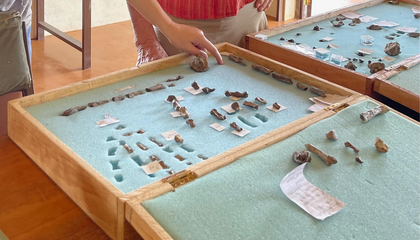
Images of flora painted on pottery dating back as far as 8,000 years may represent some of the earliest evidence of human mathematical reasoning, according to a recent study. Researchers from the Hebrew University of Jerusalem examined artifacts produced by the Halafian people, who inhabited northern Mesopotamia between 6200 BC and 5500 BC. Their findings indicate that the designs, featuring flowers with four, eight, 16, 32, or 64 petals, exhibit a pattern suggesting an early form of mathematical thought rooted in symmetry and repetition.
The research, published last month in the Journal of World Prehistory, involved an analysis of pottery fragments from 29 Halafian sites, excavated over the past century. Professors Yosef Garfinkel and research assistant Sarah Krulwich discovered that nearly all of the 375 fragments depicting floral patterns adhered to a doubling sequence. This arrangement divides a circle into symmetrical units, suggesting a level of intentionality in the design.
“It is unlikely that this strict adherence to specific numbers, repeated across various sites, was accidental,” Garfinkel stated. He posited that the Halafians may have developed this mathematical reasoning as a means to manage their increasingly complex village communities in the Near East, where agriculture and trade had transformed social dynamics over the past 4,000 years.
The researchers argue that the ability to divide space evenly, as illustrated by these floral motifs, likely had practical applications in daily life, such as allocating communal fields or sharing harvests. “These patterns reveal that mathematical thinking emerged long before the advent of writing,” Krulwich remarked. “People visualized divisions, sequences, and balance through their art.”
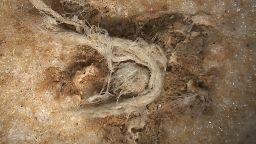
Notably, the study also highlights the importance of ethnomathematics, a field that uncovers mathematical knowledge embedded in cultural expressions by prehistoric or non-literate societies. Evidence suggests that artifacts beyond written documents may point to early mathematical concepts. For instance, some experts argue that Neanderthal string-making, dating back more than 40,000 years, demonstrates an understanding of basic numeracy.
The findings imply a significant step in the evolution of human thought. Garfinkel suggests that the understanding of basic division would have been a precursor to more complex mathematical systems. He and Krulwich emphasized that the Halafian pottery uniquely reflects an early application of symmetry in art.
In their analysis, they noted that none of the floral images depict edible crops, indicating that their purpose was likely aesthetic rather than agricultural or ritualistic. “These vessels represent the first moment in history when people chose to portray the botanical world as worthy of artistic expression,” they stated, pointing to a cognitive shift associated with village life and an increasing awareness of aesthetics.
Despite these findings, not all experts are convinced. Jens Høyrup, Senior Associate Professor Emeritus at Roskilde University in Denmark and a specialist in Mesopotamian mathematics, expressed skepticism about the researchers’ conclusions. He described the symmetry seen in the Halafian floral designs as an isolated mathematical technique rather than evidence of a broader mathematical framework.
Høyrup explained, “The ability to divide a circle nicely does not equate to a search for a geometric ascending sequence; it’s simply halving.” He acknowledged the presence of symmetry but argued that it does not indicate the existence of a formal mathematical system, describing it as “the simplest way to make divisions.”
This study adds a compelling chapter to our understanding of early human cognitive development. As researchers continue to explore the connections between art and mathematics, it becomes increasingly clear that the roots of mathematical thought may run deeper than previously acknowledged.