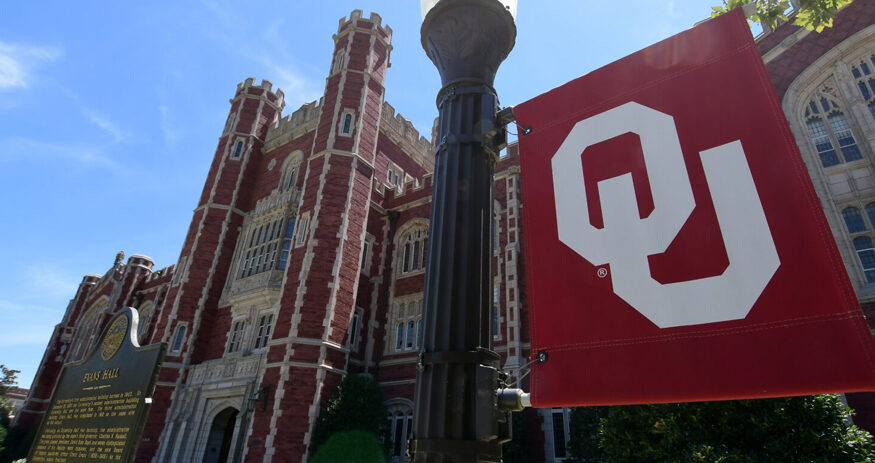
The American Association of University Professors (AAUP) has formally petitioned the University of Oklahoma (OU) for clarity regarding its handling of a controversial academic freedom case involving a student’s essay that cited the Bible. This case has attracted widespread attention since November when psychology junior Samantha Fulnecky claimed she faced illegal discrimination after receiving a zero on her assignment about gender stereotypes.
Fulnecky’s instructor, Mel Curth, criticized the essay as not adhering to the assignment guidelines and described parts of it as “offensive.” Fulnecky’s essay asserted that the belief in multiple genders is “demonic” and harmful to youth. Following the grading dispute, Curth was placed on administrative leave, and after an investigation, she was relieved of all instructional duties, a decision she is now appealing, according to civil rights attorney Brittany Stewart.
OU has since characterized Curth’s grading as “arbitrary,” yet it has not disclosed the findings of its investigation into Fulnecky’s claims of religious discrimination. The university did, however, rule in Fulnecky’s favor regarding her grade appeal. As of Monday afternoon, the petition addressed to OU President Joseph Harroz has garnered over 24,571 signatures and demands several actions from the university.
Concerns Over Academic Freedom and Instructor Safety
The petition calls for OU to release detailed information about the administrative leave process for Curth and to reaffirm the right of its instructors to teach and grade without political interference. Additionally, it seeks to establish a Harassment Response and Prevention plan to protect faculty from political attacks.
“OU’s decision to place the instructor on administrative leave following a routine grading dispute raises serious concerns about the University’s commitment to educational standards, academic freedom, and instructor safety,” the petition states. The definition of academic freedom at OU aligns with AAUP guidelines, emphasizing the importance of fostering honest academic conduct and respecting students.
Michael Givel, President of OU-AAUP, expressed that the university’s actions could undermine academic integrity. He stated, “There’s a crisis at OU… are there concrete standards regarding academic integrity, or must instructors fear complaints of discrimination based on grades?”
In light of this situation, the AAUP chapter at OU is seeking clarification on the university’s procedures for handling student discrimination complaints, noting that these processes are not documented.
Political Reactions and Legislative Implications
The controversy has sparked reactions from various political figures. Oklahoma Governor Kevin Stitt called for a review by the OU Board of Regents, while Florida Governor Ron DeSantis described the incident as indicative of “intellectual rot in higher education.”
In December, supporters of Curth gathered in large numbers at OU’s Norman campus to protest her suspension. Fulnecky has since engaged with the media and conservative groups, stating, “I was asked to give my opinion, and I gave my opinion. I’ve gotten 100% on every essay I’ve written in that class.”
In response to the situation, legislative measures are being proposed. Representative Gabe Woolley has filed House Joint Resolution 1037, which, if approved, would allow the state legislature to freeze or withhold state funds for higher education institutions within Oklahoma.
As the controversy continues to escalate, OU has not yet provided a response to the AAUP’s petition. Givel has indicated that the organization will determine its next steps if the university fails to address the demands for transparency and accountability.
This ongoing situation highlights critical issues related to academic freedom, instructor safety, and the political dynamics affecting higher education in Oklahoma.