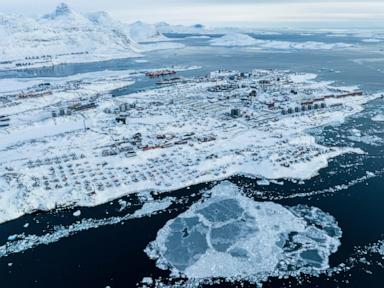
Denmark is preparing for a significant meeting with the United States next week to discuss President Donald Trump’s renewed interest in Greenland, a mineral-rich island strategically located in the Arctic. Danish Defense Minister Troels Lund Poulsen expressed that this dialogue is essential, emphasizing cooperation between Denmark and the Greenlandic government. He stated, “This is the dialogue that is needed, as requested by the government together with the Greenlandic government,” in an interview with Danish broadcaster DR.
The upcoming discussions were highlighted by U.S. Secretary of State Marco Rubio, who confirmed the meeting without specifying details on timing or participants. He remarked, “I’m not here to talk about Denmark or military intervention. I’ll be meeting with them next week, we’ll have those conversations with them then.”
Greenland, which is home to approximately 56,000 residents, predominantly of Inuit descent, will actively participate in the talks. Greenland’s Foreign Minister Vivian Motzfeldt reiterated the importance of their involvement, stating, “Nothing about Greenland without Greenland. Of course we will be there. We are the ones who requested the meeting.”
U.S. Vice President JD Vance recently indicated that he believes Denmark has not adequately secured Greenland, suggesting that Trump is prepared to take significant steps to protect American interests in the Arctic. Vance declared that Greenland is critical to U.S. national security, asserting, “the entire missile defense infrastructure is partially dependent on Greenland.” He further remarked on Denmark’s historical military alliance with the U.S., but stressed that past actions do not guarantee current effectiveness, saying, “Just because you did something smart 25 years ago doesn’t mean you can’t do something dumb now.”
The issue of Greenland’s sovereignty has gained attention following Trump’s comments about the island, which is a member of the NATO military alliance. Antonio Costa, President of the European Council, firmly stated, “Greenland belongs to its people. Nothing can be decided about Denmark and about Greenland without Denmark, or without Greenland.” His remarks reflect broader support for Greenland’s autonomy among European leaders, including those from Canada, France, Germany, Italy, Poland, Spain, and the United Kingdom.
In a historical context, the relationship between Denmark and the U.S. regarding Greenland has evolved over the years. Following Vance’s visit to Greenland in 2022, Danish Foreign Minister Lars Løkke Rasmussen highlighted the 1951 defense agreement between the two nations. He noted that the U.S. military presence in Greenland has significantly decreased since 1945, when thousands of soldiers operated across 17 bases. Today, the Pituffik Space Base, located in the northwest, is home to around 200 personnel and plays a crucial role in missile warning and defense operations.
The 1951 agreement allows for a stronger U.S. military presence in Greenland if desired, and Rasmussen indicated openness to discussions on this matter. Last year, Denmark’s parliament approved a bill to facilitate U.S. military bases on Danish soil, broadening a previous agreement with the Biden administration that granted U.S. troops access to Danish air bases.
In a move to bolster its military capabilities, Denmark has committed 14.6 billion kroner (approximately $2.3 billion) to enhance surveillance and sovereignty in the North Atlantic region. This plan includes the acquisition of three new Arctic naval vessels, two long-range surveillance drones, and expanded satellite capabilities.
Denmark’s Joint Arctic Command, based in Nuuk, is responsible for the military defense and sovereignty assertion over Greenland and the Faroe Islands. The elite Sirius Dog Sled Patrol, a unit tasked with long-range reconnaissance, also operates within Greenland’s vast wilderness.
As the dialogue between Denmark and the U.S. unfolds, the geopolitical implications surrounding Greenland’s future are likely to resonate beyond the Arctic, influencing international relations and Arctic policy discussions in the years ahead.