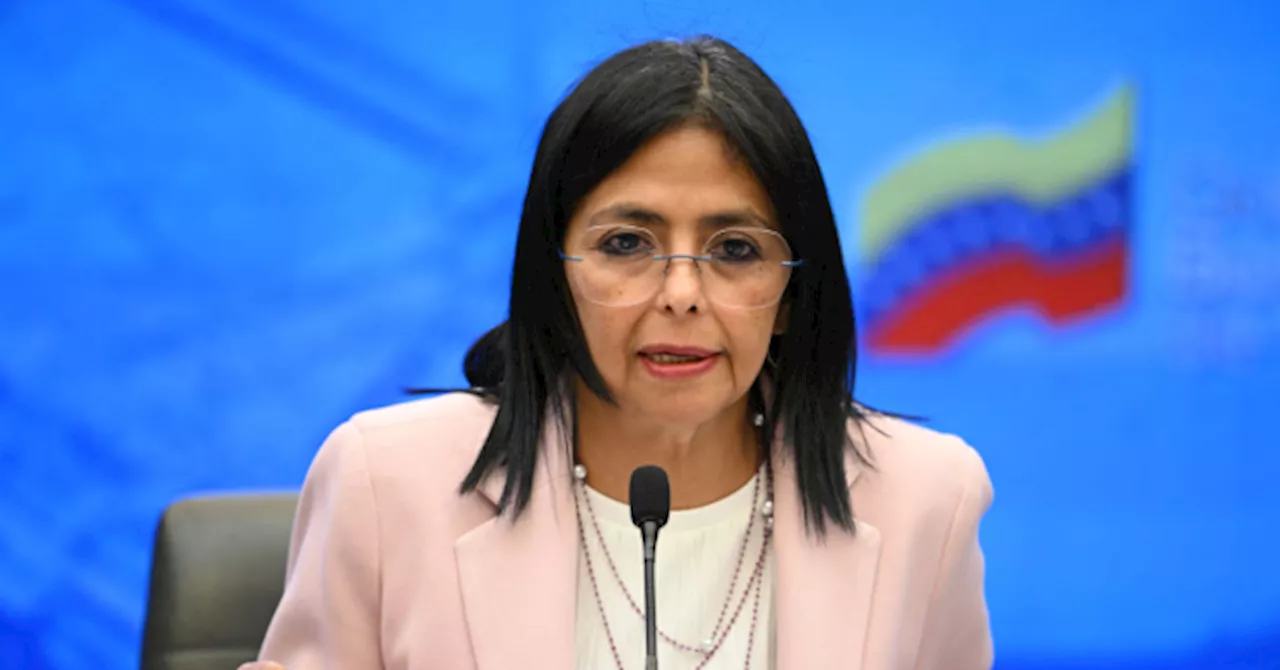
President Donald Trump announced on Saturday that Venezuelan Vice President Delcy Rodríguez has been sworn in as the head of the Venezuelan government. This follow-up comes in the wake of the reported capture of President Nicolás Maduro and his wife, Cilia Flores, during a U.S. military operation in Caracas. During a press conference, Trump revealed that Marco Rubio, Secretary of State, has engaged in discussions with Rodríguez, who expressed her willingness to collaborate with the U.S. in efforts to restore Venezuela’s stability.
Trump emphasized that Rodríguez’s appointment by Maduro does not hinder her potential role in the country’s future. “Marco is working on that directly,” Trump explained, referring to Rubio’s conversation with Rodríguez. He stated, “She’s essentially willing to do what we think is necessary to make Venezuela great again.” This phrase echoes a sentiment familiar to Trump’s political rhetoric, aimed at revitalizing the troubled nation.
Rodríguez’s Political Background
Delcy Rodríguez has held significant positions in the Maduro administration since 2018, serving as Vice President and the Minister of Oil since 2024. Her political lineage is further reinforced by her brother, Jorge Rodríguez, who leads the socialist-controlled National Assembly. This sibling alliance has become a powerful force within the Venezuelan regime, which has faced extensive international scrutiny and sanctions.
The Venezuelan constitution allows the president to appoint and dismiss the vice president freely, meaning Rodríguez’s role is not subject to popular election. Her current position raises questions about the legitimacy of the leadership transition amidst ongoing political turmoil in the country.
During the press conference, Trump also addressed the uncertainty surrounding Maduro’s whereabouts. He noted that U.S. forces encountered some injuries during the operation to detain Maduro, but fortunately, no fatalities were reported. Rodríguez has demanded proof of life for both Maduro and Flores, stating that the Venezuelan government is unaware of their current location.
International Response and Sanctions
This latest development follows a series of sanctions imposed by the U.S. Department of the Treasury and the European Union against Rodríguez, her brother, and other key figures in the Maduro administration. These sanctions are part of a broader strategy to exert pressure on the Venezuelan government, which has faced accusations of human rights violations and corruption.
In light of these events, Trump reaffirmed the U.S. commitment to guiding Venezuela through this transitional phase. He stated, “Because for us to just leave, who’s gonna take over? I mean, there’s nobody to take over.” His comments reflect the administration’s stance on maintaining a presence in Venezuela to ensure stability and prevent a power vacuum.
As the situation continues to evolve, the international community watches closely to see how the U.S. will navigate its relationship with Rodríguez and the future of Venezuelan governance. The outcome of these discussions may significantly impact the socio-political landscape of Venezuela and its citizens, who have endured years of economic hardship and political strife.