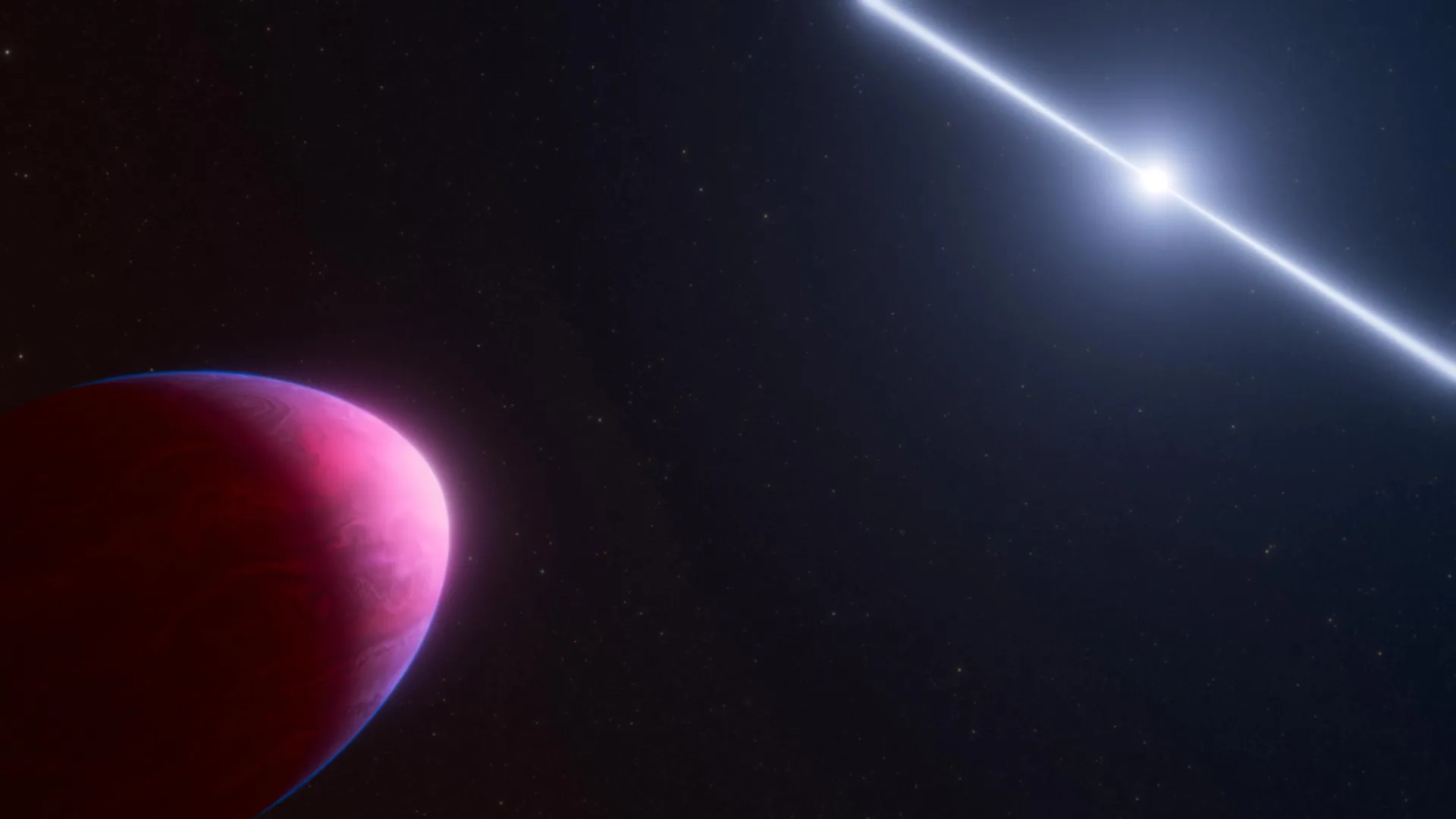
Scientists using NASA’s James Webb Space Telescope have identified an extraordinary exoplanet, PSR J2322-2650b, that challenges existing theories about planetary formation. Orbiting a city-sized neutron star, this Jupiter-mass planet features a unique carbon-rich atmosphere filled with dark soot clouds and may even contain diamonds in its core. The planet’s unusual characteristics have left researchers perplexed, as no current scientific framework adequately explains its existence.
A Unique Atmospheric Composition
The newly discovered exoplanet has a distinctive shape, resembling a lemon due to the intense gravitational forces exerted by its neutron star companion. Unlike most known exoplanets, which typically have atmospheres dominated by hydrogen and helium, PSR J2322-2650b’s atmosphere is primarily composed of helium and carbon. This unexpected composition raises questions about the processes that allowed such a planet to form.
According to Michael Zhang, an astrophysicist at the University of Chicago and principal investigator of the study, “This is a new type of planet atmosphere that nobody has ever seen before.” The research, recently accepted for publication in The Astrophysical Journal Letters, reveals that the planet’s atmosphere contains molecular carbon, specifically C3 and C2, rather than the conventional molecules like water or methane typically expected in exoplanet atmospheres.
The Planet’s Rapid Orbit and Formation Mystery
PSR J2322-2650b orbits its neutron star at an incredibly close distance of just 1 million miles, in stark contrast to Earth’s distance of approximately 100 million miles from the Sun. This proximity allows the planet to complete a full orbit in a mere 7.8 hours. Scientists suspect that the intense gravitational forces from the pulsar are responsible for the planet’s unique, stretched shape.
Despite extensive observations, the formation of PSR J2322-2650b remains a mystery. Zhang highlights the difficulty in understanding how such a carbon-enriched planet could exist, stating, “It seems to rule out every known formation mechanism.” Peter Gao from the Carnegie Earth and Planets Laboratory echoed this sentiment, recalling the team’s astonishment upon receiving the data: “What the heck is this?”
The peculiar nature of this exoplanet places it in a rare category known as a black widow system, where a rapidly spinning pulsar is paired with a smaller companion. In typical black widow systems, the pulsar strips material from its partner, increasing its spin and generating a powerful wind. However, in this case, the companion is classified as a planet rather than a star.
Future Research and Technological Advancements
The discovery of PSR J2322-2650b was made possible due to the advanced capabilities of the James Webb Space Telescope, which operates in the infrared spectrum. Positioned about a million miles from Earth, Webb’s sensitive instruments can detect faint signals that would be obscured by the heat of the Earth’s atmosphere.
Zhang emphasized the importance of Webb’s unique observational conditions: “On Earth, lots of things are hot, and that heat interferes with observations.” The telescope’s ability to capture a pristine spectrum of the planet has allowed scientists to study this system in greater detail than typical exoplanet observations permit.
Researchers like Roger Romani from Stanford University have proposed hypotheses to explain the planet’s unusual atmosphere. Romani suggests that as the companion cools, a mixture of carbon and oxygen inside the planet may crystallize, leading to the formation of pure carbon crystals that mix with helium, resulting in the observed atmospheric signature. However, the precise mechanisms remain unclear and will require further investigation.
As scientists continue to explore the implications of this remarkable discovery, the ongoing research promises to deepen our understanding of planetary systems and the diverse forms they can take in the universe. The findings not only challenge existing paradigms but also ignite curiosity about the vast possibilities that lie beyond our solar system.