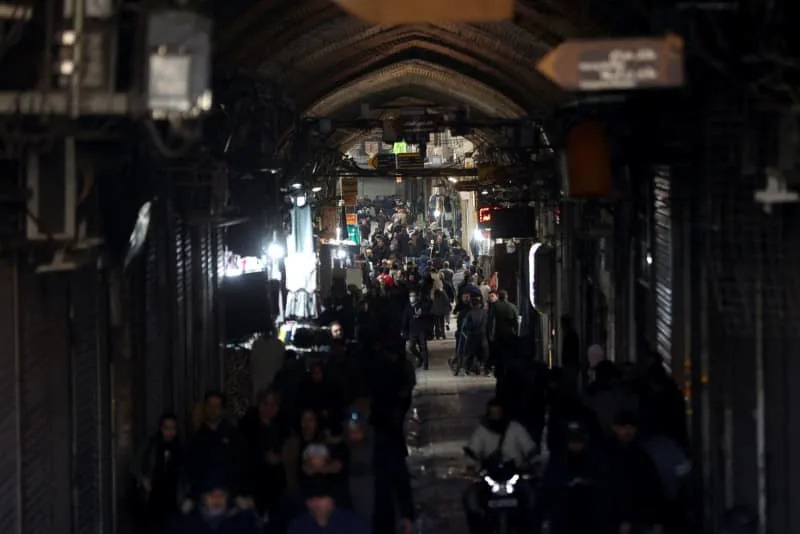
Protests erupted across Iran as citizens voiced their discontent over the country’s worsening economic situation, leading to a significant crackdown by authorities. Demonstrators took to the streets amid a backdrop of rising inflation, a collapsing currency, and political dissatisfaction. In various locations, including Tehran’s Jomhuri Street and Kermanshah, footage showed large crowds confronting police, resulting in the use of tear gas and the arrest of numerous individuals.
Among those detained was Mehdi Biek, the political editor of Iran’s Etemad newspaper, who was apprehended while covering the protests. His wife reported that she had not heard from him for over 24 hours until his release on Tuesday. Reports indicate that at least 11 people were arrested on Sabunian Street in Tehran, illustrating the scale of the authorities’ response to the unrest.
The protests stem from a rapid decline in the value of the Iranian rial, which has plummeted nearly 90% since 2018. As of Tuesday, the currency traded at 1.4 million rials per US dollar, a record low reflecting the deepening economic crisis. Demonstrators chanted slogans such as “Neither Gaza nor Lebanon, I will sacrifice my life for Iran,” indicating that grievances extend beyond economic issues to encompass broader discontent with the government.
Masih Alinejad, an Iranian dissident journalist, remarked on the significance of the current protests, stating, “What we are witnessing in Iran right now is not an isolated economic protest. It is another deep and serious challenge to the legitimacy of the Islamic Republic.” This unrest echoes previous protests sparked by the death of Mahsa Amini, who was killed in police custody last year, an event that ignited widespread outrage and dissent against the regime.
Government Response and Economic Measures
In response to the protests, Iranian authorities attempted to deflect blame onto foreign adversaries while also acknowledging public grievances. President Masoud Pezeshkian expressed concern for the livelihoods of citizens, stating, “I have tasked the Minister of the Interior to hear the legitimate demands of the protesters through dialogue with their representatives.” This statement reflects an effort to engage with the public amid rising tensions.
Additionally, the government has announced a 30% increase in public sector salaries for the upcoming year, up from the previously planned 20%. This decision comes as members of the regime face heightened criticism and some officials resign in light of ongoing unrest. Massoud Pezeshkian, a prominent member of the information council, acknowledged the growing dissatisfaction, stating, “I cannot defend the government” given the widespread criticism from citizens.
Violence Against Student Protesters
While the government has appeared to adopt a more conciliatory tone towards the general populace, its response to student protests has been notably more severe. Reports from Iran International detail incidents where student gatherings were met with violence, including attacks by the Islamic Revolutionary Guard Corps (IRGC) and its paramilitary wing, the Basij. A student was severely injured during one such incident near Tehran’s Amirkabir University.
Several students were arrested during campus protests, including Mobin Aminian, a chemical engineering undergraduate, and Shahin Shokouhi, a PhD sociology student. These actions have raised concerns about the treatment of young activists and the government’s willingness to suppress dissent within educational institutions.
The ongoing turmoil in Iran illustrates a complex interplay of economic distress and political discontent. As citizens continue to express their frustrations, the regime faces mounting challenges to its authority and legitimacy. The situation remains fluid, with potential implications for both domestic stability and international relations as the world watches closely.