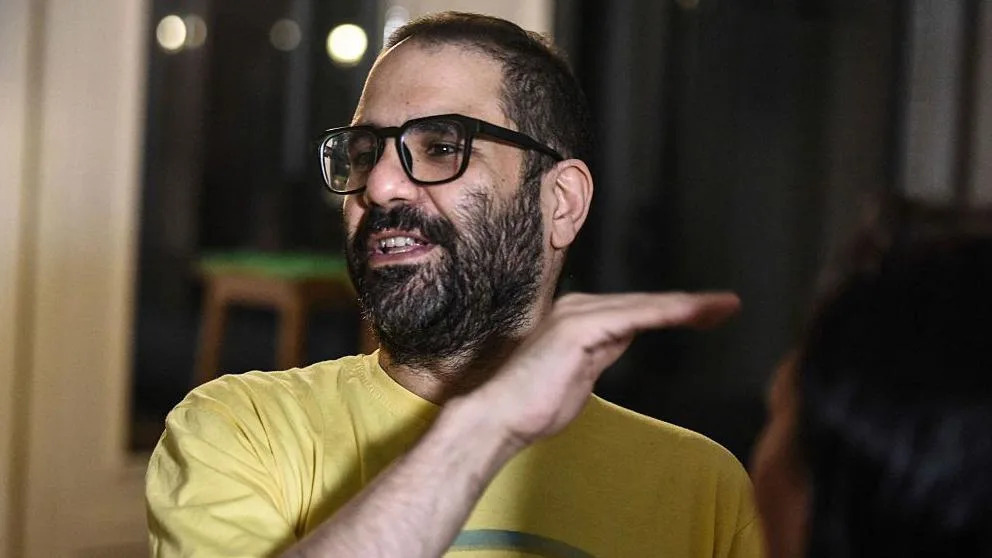
Alaa Abdel Fattah, an Egyptian democracy activist, has issued an apology for controversial tweets that have resurfaced as calls for his deportation from the United Kingdom intensify. Abdel Fattah, a dual national, recently arrived in the UK after being released from prison in Egypt, where he served time for charges related to “spreading fake news.” His statement follows a growing political backlash, particularly from Conservative and Reform UK leaders.
The tweets in question, dating back to 2012, include statements calling for violence against Zionists and police. Following their revival on social media, Conservative leader Kemi Badenoch and Reform UK leader Nigel Farage have urged Home Secretary Shabana Mahmood to consider revoking Abdel Fattah’s citizenship to facilitate his removal from the UK. Farage described Abdel Fattah’s views as “racist and anti-British,” asserting that such sentiments have no place in the country.
In response to the outcry, Abdel Fattah stated, “I do understand how shocking and hurtful they are, and for that I unequivocally apologise.” He expressed dismay that his historic tweets were being used to question his integrity just as he was reuniting with his family after 12 years apart. He emphasized that he takes allegations of antisemitism seriously, though he contended that some of his posts have been “completely twisted out of their meaning.”
Political Reactions and Concerns
The political landscape surrounding Abdel Fattah’s case has been charged. Sir Keir Starmer, leader of the Labour Party, faced criticism for expressing delight at Abdel Fattah’s arrival in the UK, reportedly unaware of the controversial content of his tweets. Meanwhile, Chris Philp, the Shadow Home Secretary, stated he did not know the specifics of the tweets when he was in office but believes now that Abdel Fattah should have his citizenship revoked. He remarked, “There is no excuse for what he wrote,” highlighting the need for accountability for hateful language.
The UK government has a legal obligation under international law to avoid rendering individuals stateless. British citizenship can only be rescinded if the individual is eligible for citizenship in another country. Abdel Fattah was granted UK citizenship in December 2021 through his mother, a London-born British citizen.
The Foreign Office acknowledged its longstanding commitment to securing Abdel Fattah’s release and reuniting him with his family, but condemned his past social media posts as “abhorrent.” The case has also drawn attention from the Board of Deputies of British Jews, which expressed profound concern over Abdel Fattah’s past rhetoric. Adrian Cohen, the board’s senior vice-president, stated, “His previous extremist and violent rhetoric aimed at ‘Zionists’ and white people in general is threatening to British Jews and the wider public.”
Abdel Fattah’s Background and Current Situation
Alaa Abdel Fattah is well-known for his activism and role in the 2011 Egyptian uprising that led to the resignation of former President Hosni Mubarak. Over the years, he has faced significant challenges, spending more than a decade in prison due to his advocacy against police brutality and repression of LGBTQ+ rights in Egypt. His release in September 2023 followed a prolonged campaign by his family and lobbying efforts from the British government.
In 2014, he was nominated for the Sakharov Prize for Freedom of Thought but lost the nomination due to his inflammatory tweets about Israel. Abdel Fattah contends that his remarks were part of a “private conversation” taken out of context during a tumultuous period in Gaza.
Now, after being removed from a travel ban list imposed by Egyptian authorities, he has reunited with his 14-year-old son, who resides in Brighton. Abdel Fattah continues to advocate for human rights and intends to rebuild his life after years of imprisonment.
As the political discourse evolves, the future of Abdel Fattah in the UK remains uncertain, with significant pressure from various political factions to address his past statements and their implications for national values.