Residents of Central Oregon are navigating the difficulties of life without a personal vehicle, facing challenges that extend beyond mere inconvenience. Individuals like Mark Schuette, 74, are grappling with the implications of a driver’s license suspension that has forced them to adapt to a car-free lifestyle. Schuette’s predicament began three months ago when he was involved in an accident with an uninsured vehicle. This incident has left him without a license until well into 2026, despite a recent change in state legislation that would have alleviated his situation had it taken effect earlier.
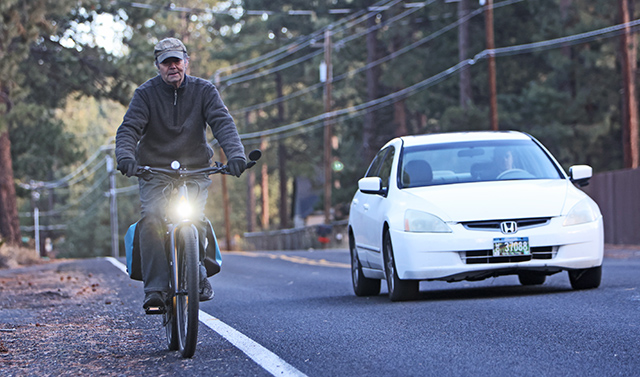
Schuette, who is known for inventing a dog-powered scooter, now relies on a pedal-assist e-bike for his daily activities, including grocery shopping and attending business appointments. Living approximately six miles from downtown Bend, he navigates roads that lack bike lanes or sidewalks, making his journey perilous as cars speed by at 40 miles per hour. “It’s just burned into my brain what a hassle not having a vehicle is,” he remarked, highlighting the car-centric nature of society.
Statistics on Non-Drivers Reveal a Larger Trend
Schuette’s struggles are emblematic of a larger trend affecting millions in the United States. According to the Federal Highway Administration, there are approximately 238 million drivers in a nation with a population of 335 million, indicating that around 29% of people cannot legally drive. A study from the National Resource Defense Council found that 36% of Americans over the age of ten do not rely on personal vehicles. Moreover, data from Hedges & Company reveals that while 90% of those of driving age hold licenses, many still face transportation barriers.
The shift in urban planning to accommodate non-drivers has started to take root in Bend and Central Oregon, where policies are beginning to prioritize pedestrians and cyclists. Local surveys suggest that about 80% of people drive to downtown Bend during the summer months, with this figure rising to 90% in winter. Concerns about reduced car access have prompted responses from local business groups, fearing economic repercussions as the city explores options for a low-car “people street” project.
Real-Life Challenges of Public Transportation
For many residents, the absence of a car translates into significant hurdles. Becky Salmon, 65, transitioned from living in her car to utilizing a three-wheeled bicycle after securing housing. Following an accident that damaged her bicycle, Salmon found herself dependent on the local bus system. Unfortunately, her experiences have been fraught with delays and missed appointments, primarily due to unreliable bus schedules. “I’ve missed appointments because of it,” she explained, underscoring the challenges faced by those who rely on public transport.
The local transit agency, Cascades East Transit, plans to reinstate fare charges starting February 1, 2026, with each ride costing $2. While aimed at expanding services, this development may pose further challenges for low-income individuals who rely on public transport. The agency has recently improved its services by adding new routes and extended hours, yet inconsistencies remain, particularly during peak times.
As discussions surrounding transportation funding continue, plans for an on-demand rideshare service for underserved communities like Deschutes River Woods remain uncertain. This service could provide essential support for residents like Schuette, who may soon face winter weather that complicates biking.
Schuette expressed his hope for a “hardship permit” to allow limited car usage during the winter months, acknowledging the risks that come with cycling in adverse conditions. “Once we get snow and ice, I could easily crash at some point,” he noted, reflecting the precarious nature of life without reliable transportation.
As Central Oregon navigates the complexities of car-less travel, the experiences of individuals like Schuette and Salmon highlight the pressing need for more inclusive transportation solutions. Transitioning away from car dependency may require a concerted effort from local authorities to ensure that all residents have access to safe and efficient means of travel.