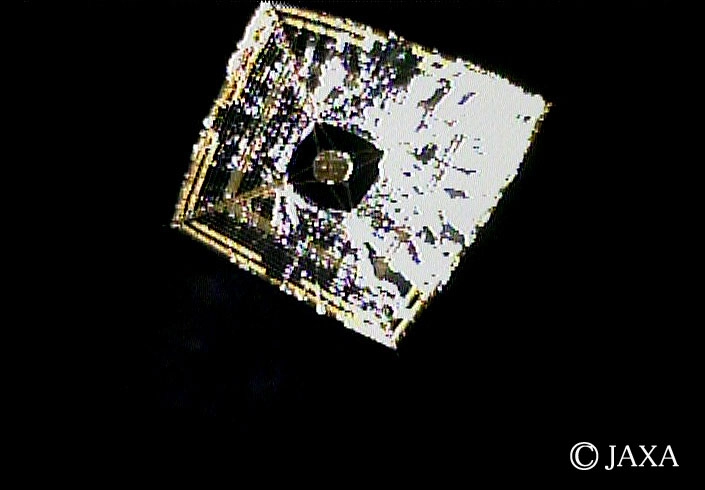
Recent advancements in solar sail technology could revolutionize space propulsion. A study by researchers Gulzhan Aldan and Igor Bargatin from the University of Pennsylvania presents a novel method for steering solar sails using a technique called kirigami. This approach, detailed in a preprint available on arXiv, offers a more efficient way to navigate without the use of propellant.
Traditional solar sails rely on methods like reaction wheels or tip vanes for maneuvering. Reaction wheels, commonly found on satellites, are heavy and require propellant, limiting the sail’s effectiveness. Tip vanes, which are small mirrors at the edges of the sail, can malfunction, leaving the sail unable to steer. The latest innovation, kirigami, takes advantage of intentional cuts in the sail material, allowing it to change shape and direction more easily.
The kirigami technique involves creating a grid of cuts in the sail made from aluminized polyimide film. When the sail is pulled, these cuts enable the material to buckle, transforming it into a three-dimensional surface. This alteration allows individual segments of the sail to tilt relative to the light source, functioning like thousands of tiny mirrors. As light reflects off these segments at varying angles, the sail is pushed in the opposite direction, achieving effective propulsion.
While the system does require some electrical power, it is minimal compared to existing technologies. The kirigami sail uses servo motors that operate only when necessary, in contrast to Reflectivity Control Devices (RCDs) used in the IKAROS mission of 2010, which continuously drain battery power. The researchers evaluated their method through simulations using COMSOL, a physics simulation software, and conducted physical experiments using lasers to confirm their predictions.
In simulations, the force exerted on the sail was measured at 1 nN per Watt of sunlight. While this force may seem small, it is sufficient for maneuvering a small solar sail and its payload over time. The physical tests involved stretching the film in a test chamber while directing a laser at it, successfully demonstrating the predicted outcomes for various strain levels.
The potential of this kirigami-based technology could significantly reduce energy and propellant costs associated with turning solar sails. However, the competitive landscape for solar propulsion technologies remains robust, with several alternatives vying for validation through experimental missions. As such, it may take time before kirigami sails are deployed in actual space missions.
The implications of this research are promising for the future of solar sailing, where innovative methods could lead to more efficient and versatile space exploration capabilities. As technology progresses, the visual impact of these sails in action is sure to be breathtaking.
For further reading, see the original paper by G. Aldan and I. Bargatin titled “Low-Power Solar Sail Control using In-Plane Forces from Tunable Buckling of Kirigami Films.”