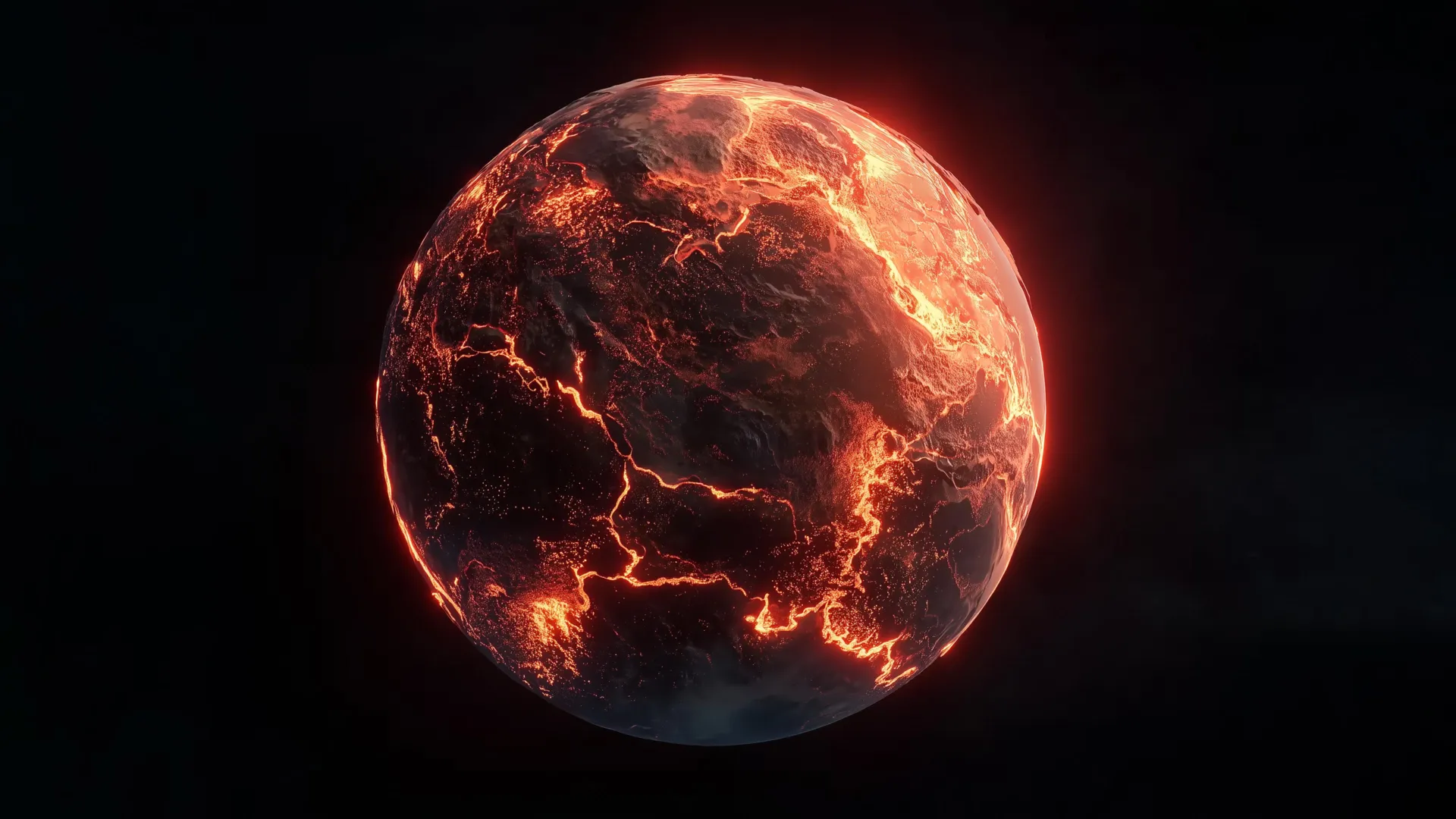
A groundbreaking study has revealed that significant amounts of water may have been securely stored deep within Earth’s mantle during its formative years. Conducted by a team led by Prof. Zhixue Du from the Guangzhou Institute of Geochemistry at the Chinese Academy of Sciences, this research suggests that these hidden water reservoirs played a crucial role in transforming the planet from a molten inferno into the life-supporting world we inhabit today.
The findings, published in the journal Science on December 11, 2025, challenge long-held assumptions about the water content of Earth’s lower mantle. Previous studies indicated that this region was nearly devoid of water, but the recent experiments demonstrate that the mineral bridgmanite can store far more water at elevated temperatures than scientists had previously believed.
New Insights into Water Storage
Approximately 4.6 billion years ago, Earth was an environment of extreme heat and turmoil, characterized by a surface covered in molten rock. As the planet began to cool, the question of how water survived this fiery phase has intrigued scientists for decades. The research team discovered that bridgmanite, the most prevalent mineral in the mantle, functions like a tiny reservoir for water, potentially holding quantities comparable to today’s oceans.
To investigate this phenomenon, the researchers faced significant challenges. They needed to replicate the extreme pressures and temperatures found over 660 kilometers beneath the Earth’s surface. Utilizing a diamond anvil cell combined with laser heating techniques, the team achieved temperatures nearing 4,100 °C. This setup allowed them to accurately assess how bridgmanite interacts with water under conditions reflective of the early Earth.
Revolutionary Techniques and Findings
Employing advanced analytical tools, including cryogenic three-dimensional electron diffraction and NanoSIMS, the researchers mapped the distribution of water within bridgmanite at an unprecedented resolution. Collaborating with Prof. LONG Tao from the Institute of Geology of the Chinese Academy of Geological Sciences, they also applied atom probe tomography, which functioned like a chemical CT scanner for microscopic samples.
The experiments revealed a significant increase in bridgmanite’s water retention capabilities at higher temperatures, suggesting that during the early stages of Earth’s cooling, this mineral could have stored water volumes much larger than previously estimated. The new model indicates that the lower mantle could contain water amounts ranging from 0.08 to 1 times the volume of Earth’s current oceans, representing a reservoir five to one hundred times larger than earlier estimates.
This deeply stored water did not remain isolated; rather, it acted as a lubricant for geological processes. By lowering the melting point and viscosity of mantle rocks, the water facilitated internal circulation and plate movement, contributing to Earth’s geological dynamism. Over millions of years, some of this water was gradually returned to the surface through volcanic activity, playing a vital role in the formation of the planet’s early atmosphere and oceans.
The implications of this research are profound. The presence of these hidden water reservoirs may have been instrumental in Earth’s transition from an inhospitable environment to one that nurtured life. Understanding the dynamics of water in the mantle not only reshapes our view of Earth’s geological history but also provides insights into the processes that sustain life on our planet.
As scientists continue to explore the depths of Earth’s mantle, this study marks a significant step forward in unraveling the complexities of our planet’s evolution, revealing how the secrets buried beneath our feet have shaped the world we know today.