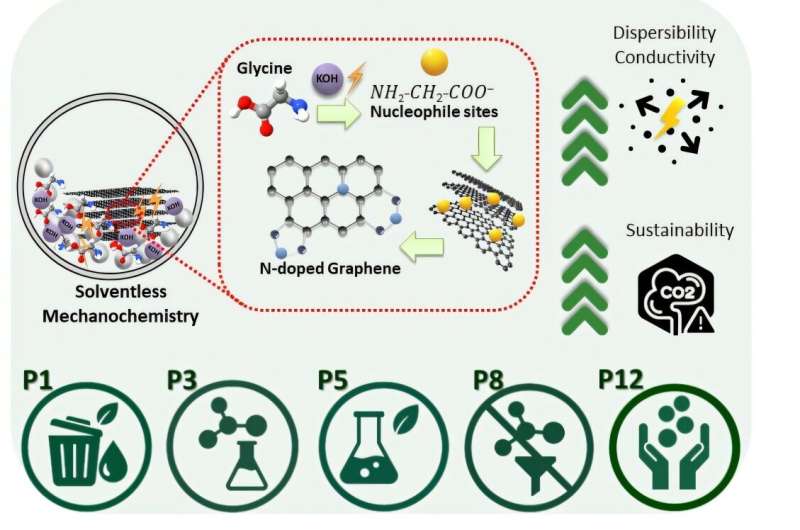
Advancements in sustainability are fueling innovation in the development of functionalized graphene materials, according to a recent study published in ACS Sustainable Chemistry & Engineering. Researchers from Monash University, led by doctoral candidate Chamalki Madhusha, have explored a new solvent-free, bio-derived mechanochemical approach to produce nitrogen-doped graphene nanoplatelets. This method aims to reduce the environmental impact of traditional graphene production techniques.
Graphene is often hailed as a remarkable material due to its strength, electrical conductivity, and versatility. Despite its potential, many applications remain confined to laboratory settings due to significant challenges associated with its functionalization. Pristine graphene lacks the ability to dissolve in common solvents, which necessitates complex and often environmentally harmful processes for modification.
One major hurdle in utilizing graphene effectively is the need for chemical modification to improve dispersibility for advanced applications, such as smart coatings and conductive composites. Traditional nitrogen doping methods involve toxic precursors, harsh purification processes, and high-temperature treatments, all of which contribute to a troubling environmental footprint.
In response, Madhusha and her colleagues have turned to mechanochemistry—a technique that harnesses mechanical forces to induce chemical reactions. This innovative approach eliminates the need for solvents, reduces energy consumption, and simplifies the scaling of production. Utilizing a ball-milling process, the team successfully functionalized graphite with a bio-derived nitrogen source (amino acids) under ambient conditions, resulting in nitrogen-doped graphene nanoplatelets (N-GNPs) produced without harmful reagents.
The researchers not only focused on the performance of the new material but also evaluated its sustainability. They applied both qualitative and quantitative metrics, including waste generation and overall energy demand. The mechanochemical process yielded approximately 80% material yield, a notable achievement for a solid-state synthesis route. Most significantly, the method demonstrated a lower environmental impact as measured by the E-factor, a standard metric in green chemistry that assesses waste generation per unit of product.
The incorporation of nitrogen into the graphene lattice enhances its properties, improving electrical conductivity, chemical reactivity, and interactions with surrounding polymers. The resulting N-GNPs retained high structural quality while offering significant functional benefits. When used as nanofillers, they exhibited strong potential to enhance the performance of composite systems, addressing both sustainability and functionality.
An intriguing application of this research is the compatibility of N-GNPs with vitrimers—a class of polymers that combine the strength of thermosets with the reprocessability of thermoplastics. When integrated into vitrimer matrices, the N-GNPs act as multifunctional fillers, enabling electrically triggered self-healing, enhancing mechanical strength, and improving thermal and electrical conductivity. This breakthrough could lead to the development of repairable coatings and recyclable composites, reinforcing the importance of balancing performance with sustainability.
The implications of this research extend beyond graphene. It highlights the necessity of rethinking advanced materials production methods, particularly as industries seek to reduce their environmental footprint. Mechanochemical, solvent-free strategies can pave the way for sustainable manufacturing processes that are both cost-effective and compliant with safety regulations.
Looking forward, the research team aims to adapt this green synthesis approach to explore other dopants and composite systems, as well as scalable manufacturing routes. The objective is to not only create superior materials but also to establish more sustainable production methods in the rapidly evolving landscape of advanced materials.
As demand for innovative functional materials continues to rise, the integration of sustainability in their design and production will be crucial. The findings from this study represent a significant step toward aligning nanomaterials innovation with broader sustainability goals, presenting a promising pathway for future research and applications in various industries, including electronics, aerospace, and energy storage.