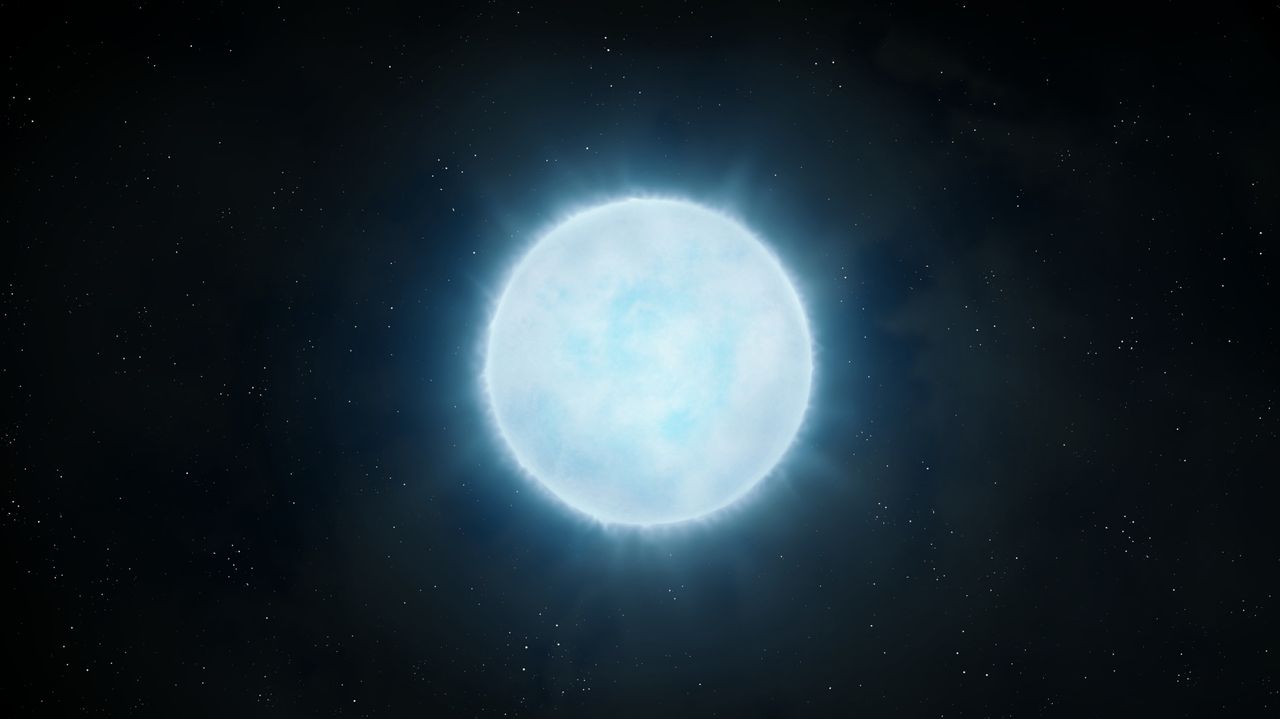
Research into mysterious particles known as axions is gaining momentum as astronomers explore the implications of these hypothetical entities on white dwarfs, the remnants of dying stars. A recent study published in November 2025 on the open-access server arXiv sheds light on how axions could potentially influence the behavior of these dense stellar remains.
Astronomers have long been intrigued by axions, theoretical particles proposed in the 1970s to address challenges associated with the strong nuclear force. Initially, efforts to detect them in particle collider experiments were unsuccessful, leading to a decline in interest. However, renewed research suggests that axions may hold the key to explaining dark matter, a substance that makes up a significant portion of the universe yet eludes direct observation.
This latest study focused on white dwarfs, which can contain the mass of the sun in a volume smaller than Earth. These stellar remnants maintain stability through a phenomenon known as electron degeneracy pressure, where the behavior of electrons prevents collapse under gravity. The research team proposed that if axions are indeed produced by electrons, the rapid movement of electrons within white dwarfs could lead to substantial axion production.
As axions escape from the white dwarfs, they would draw energy away from these stars, causing them to cool more quickly than expected. To investigate this theory, researchers developed a model that simulates the evolution of stars, predicting their temperature and brightness over time based on axion cooling effects.
After applying this model, researchers examined data collected from the globular cluster 47 Tucanae using the Hubble Space Telescope. This cluster was an ideal subject for study, as all its white dwarfs were formed around the same time, providing a consistent sample size.
The findings revealed no evidence of axion cooling among the white dwarf population within the cluster. However, the study did yield significant insights into the interaction between electrons and axions, indicating that electrons cannot produce axions more efficiently than once every trillion attempts. While this does not entirely rule out the existence of axions, it suggests that direct interactions between electrons and axions are unlikely.
As research continues, astronomers are urged to explore more innovative methods for detecting axions. The quest for understanding these elusive particles remains critical in unraveling the mysteries of dark matter and the fundamental nature of the universe. This study not only enhances our knowledge of white dwarfs but also clarifies the limitations of current axion models, guiding future investigations in this fascinating field.