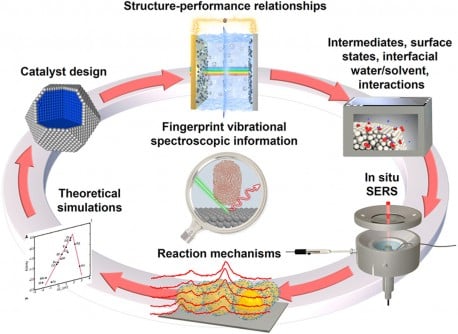
In a significant advancement in electrochemical research, a review published in March 2025 in the journal eScience details the use of in situ electrochemical surface-enhanced Raman spectroscopy (EC-SERS) to gain unprecedented insights into reaction mechanisms. This innovative technique amplifies Raman signals at plasmonic nanostructures, allowing for real-time detection of interfacial species during various chemical reactions.
The review, summarized by a team of researchers, emphasizes how in situ EC-SERS captures fingerprint vibrational signals of trace and transient interfacial species under operational conditions. By monitoring the dynamic evolution of Raman peaks, EC-SERS demonstrates how the properties of electrocatalysts and their surrounding environments influence reactions related to fuel cells, water electrolysis, and carbon dioxide reduction (CO2 RR).
Through these findings, researchers have established direct correlations between interfacial species, reaction pathways, and mechanisms, providing crucial guidance for designing high-performance electrocatalysts and electric double layers (EDL) for sustainable energy technologies.
Revolutionizing Electrocatalytic Studies
The comprehensive review outlines the principles, substrate-engineering strategies, and experimental designs that facilitate the coupling of Raman enhancement with electrochemical control. It highlights how EC-SERS identifies key intermediates such as H*, OH*, OOH*, COOH*, and surface oxides. Using potential-dependent Raman shifts and isotope tracing, the technique achieves a molecular-level perspective that enhances the understanding of reaction pathways and mechanisms under operating conditions.
One of the core concepts discussed is the role of localized surface plasmon resonance (LSPR) on metal nanostructures, specifically those made from gold (Au), silver (Ag), and copper (Cu). These structures create intense electromagnetic “hotspots,” amplifying Raman signals significantly and enabling the detection of species at the monolayer level.
The review also summarizes strategies for constructing SERS substrates, including electrochemical roughening and the creation of core-shell nanoparticles, which are essential for electrocatalysts lacking intrinsic Raman activity.
Insights from Case Studies
Case studies included in the review illustrate the practical applications of EC-SERS. For instance, the technique differentiates between associative and dissociative oxygen-reduction pathways on platinum (Pt) single crystals, reveals valence-state-dependent hydrogen-evolution kinetics on ruthenium (Ru) surfaces, and identifies bifunctional hydrogen/hydroxyl interactions that regulate alkaline hydrogen-oxidation activity in Pt-based alloys.
Furthermore, EC-SERS exposes the structural evolution of interfacial water, including its hydrogen-bond network and orientation, providing insights that other characterization tools cannot achieve. The review notes that by integrating EC-SERS with density functional theory (DFT) and ab initio molecular dynamics (AIMD) simulations, researchers can correlate vibrational frequencies with adsorption energies, reaction barriers, and electric-double-layer structures.
The authors assert that EC-SERS offers “molecular-level clarity that was previously unattainable in operando electrocatalysis.” They emphasize that subtle shifts in vibrational modes can track the reorganization of electrocatalytic surfaces, the appearance or disappearance of reaction intermediates, and the modulation of electron-proton transfer by interfacial water and cations.
This ability to visualize species under working conditions transforms EC-SERS into a critical tool bridging spectroscopy and theoretical modeling. By validating computational predictions and refining reaction models, the technique provides researchers with a robust analytical framework to design more efficient electrocatalysts and EDLs.
The authors also highlight the potential of EC-SERS in advancing hydrogen production, fuel cells, carbon dioxide utilization, and other sustainable energy technologies. By elucidating how binding energies, surface electronic structures, and interfacial solvation influence key reaction steps, the method guides precise tuning of electrocatalyst composition, morphology, and active-site configuration.
Looking ahead, future developments in EC-SERS—such as broader potential windows, multimodal spectroscopic integration, and machine-learning-assisted spectral interpretation—could establish the technique as a standard diagnostic tool for operando catalysis. Ultimately, this approach supports the accelerated development of high-efficiency, durable energy-conversion systems crucial for a low-carbon future.
This research was funded by the National Natural Science Foundation of China and the Natural Science Foundation of Fujian Province, among others. The significance of this work underscores the ongoing efforts to enhance the field of electrochemistry and its applications in sustainable energy.