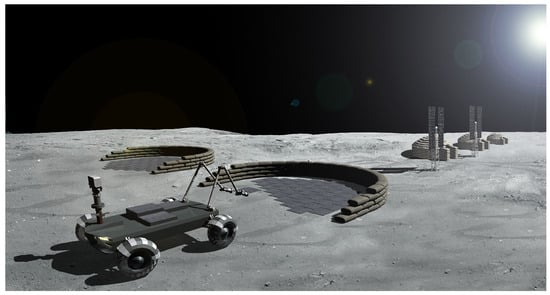
Engineers at Purdue University have outlined a groundbreaking approach to constructing lunar landing pads using local materials, as detailed in a recent paper published in Acta Astronautica. Led by Shirley Dyke, the team addresses the pressing need for durable landing surfaces on the Moon, essential for the safe operation of rockets and the establishment of lunar bases.
Understanding the unique challenges of building on the Moon is critical. Unlike the construction of terrestrial structures, which benefit from well-documented materials, engineers lack comprehensive data on lunar regolith—the Moon’s surface material. This scarcity of information poses significant challenges, especially given the high costs associated with transporting materials from Earth.
Designing for Safety and Durability
The necessity for a structured landing pad arises from the potential hazards posed by rocket landings. Rockets, including those planned for use in lunar missions, generate intense plumes that can displace rocks and dust, risking damage to both the landing craft and any nearby infrastructure. While rockets like SpaceX’s Starship could theoretically land anywhere flat, engineers advocate for dedicated landing pads to mitigate these risks.
Traditional landing pads on Earth have been meticulously designed and tested over decades, offering a robust template for future lunar versions. Yet, replicating these structures using lunar regolith is not straightforward. The process of sintering, which involves heating regolith to create a solid form, is still poorly understood in terms of the mechanical properties of the resulting material.
Dr. Dyke pointed out that simulants—materials designed to mimic lunar regolith—cannot fully replicate the Moon’s unique environment. Thus, the only way to accurately assess the material’s performance is through in-situ testing on the lunar surface.
Addressing Uncertainties in Material Properties
The primary factors in designing a lunar landing pad include its mechanical and thermal properties. Engineers need to consider how the material will respond to stress and strain, as well as its behavior under extreme temperature fluctuations that occur during the lunar day/night cycle.
Preliminary estimates suggest that sintered regolith likely exhibits brittleness, being weaker under tension than compression. This raises concerns about the pad’s ability to withstand the forces exerted by landing rockets, particularly as thermal expansion and contraction could lead to cracking. Dr. Dyke’s team recommends that a landing pad designed for a 50-ton lander should ideally be about 14 inches thick to balance structural integrity with the risks of thermal stress.
The potential for failure modes such as spalling, where pieces of the pad chip off due to thermal fluctuations, poses additional challenges. Over time, repeated landings could degrade the pad’s structural integrity, necessitating careful monitoring and maintenance.
To address these uncertainties, the authors propose an iterative approach to pad development, starting with early lunar missions focused on gathering data about regolith properties. These missions would enable crucial in-situ testing under the Moon’s low-gravity conditions, which are difficult to replicate on Earth.
As the design process progresses, the integration of robotic systems—either teleoperated or fully autonomous—will be essential for constructing and maintaining lunar landing pads. The complexities of working in the Moon’s harsh environment, particularly for humans in bulky space suits, make robotic assistance indispensable.
With NASA and other space agencies actively pursuing plans to return humans to the Moon, the timeline for building these landing pads remains uncertain. However, the research conducted by Dr. Dyke and her team represents a significant step toward ensuring safe and effective operations on our nearest celestial neighbor. The ultimate goal is to establish a reliable infrastructure that not only facilitates landings but also supports the long-term exploration and utilization of lunar resources.
Through continued testing and refinement of their models, engineers hope to develop lunar landing pads that can withstand the unique challenges of the Moon, paving the way for future missions and potential colonization efforts.