NASA’s Europa Clipper spacecraft recently made a groundbreaking observation of the interstellar comet 3I/ATLAS, providing critical data while Earth-based telescopes struggled to capture the comet’s activity. Utilizing its Ultraviolet Spectrograph (UVS), developed by the Southwest Research Institute (SwRI), the spacecraft observed the comet’s dust and plasma tails from a unique vantage point, revealing insights into its composition and behavior.
Launched in 2024, the Europa Clipper is set to reach the Jovian system by 2030. The spacecraft’s recent observations of 3I/ATLAS were particularly significant, as the comet became the third confirmed interstellar object to enter our solar system in July. The UVS instrument collected ultraviolet data during a period when viewing from both Earth and Mars was severely hampered due to the comet’s proximity to the Sun.
Dr. Kurt Retherford, principal investigator for Europa-UVS, expressed enthusiasm about the unexpected opportunity to study the comet. “Our observations have allowed for a unique and nuanced view of the comet,” he stated, highlighting the importance of the findings for understanding the comet’s activity during its closest approach to the Sun.
Unprecedented Observations from a New Angle
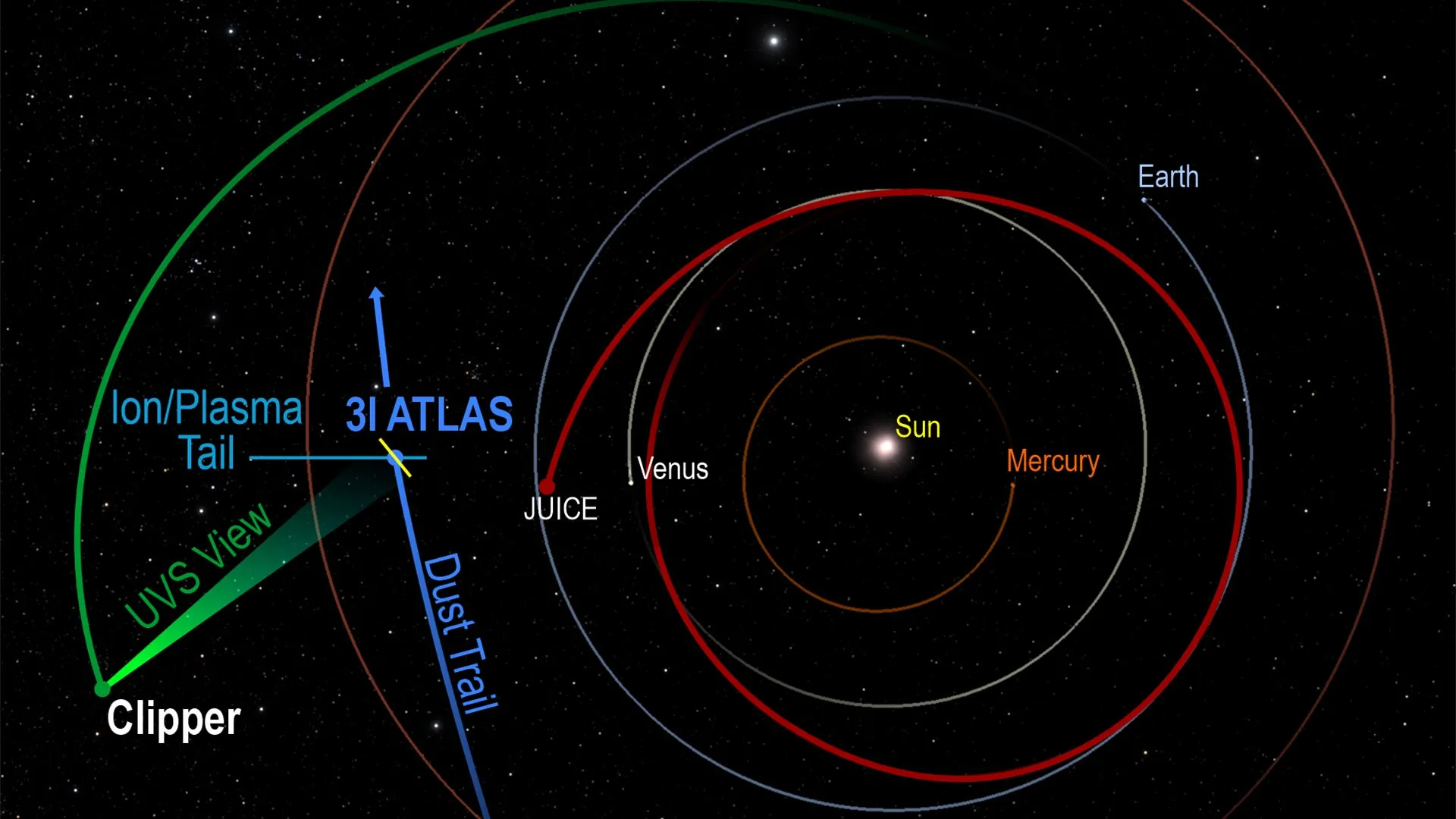
The Europa Clipper’s position allowed for a rare look at the comet’s tails, which usually consist of a dust tail that trails behind and a plasma tail that extends away from the Sun. The spacecraft’s vantage point offered a downstream view of both tails, looking back toward the comet’s nucleus and the surrounding coma of gas.
Simultaneously, the observations from the SwRI-led UVS aboard the European Space Agency’s Jupiter Icy Moons Explorer (JUICE) provided an anti-sunward perspective, enhancing the overall data collection and offering a more typical angle during the same timeframe. Dr. Thomas Greathouse, co-deputy principal investigator of Europa-UVS, noted the collaborative effort to piece together a comprehensive understanding of the comet’s geometry.
The data collected identified significant signatures of oxygen, hydrogen, and dust, suggesting high outgassing activity following the comet’s closest solar approach. “We can see gases come off the comet, and water molecules break apart into hydrogen and oxygen atoms,” Dr. Retherford explained, emphasizing the spacecraft’s capabilities in measuring fundamental atomic transitions.
Understanding the Comet’s Origins
These observations not only provide insights into the comet’s structure but also raise questions about its origins beyond our solar system. Dr. Tracy Becker, co-deputy principal investigator of Europa-UVS, addressed the broader implications of understanding the comet’s composition. “What are the chemical processes at play, and how can we unravel the comet’s origin in its own star system?” she asked. “Those are big questions.”
The information gathered could shed light on the conditions under which comets form around other stars, potentially offering parallels to the processes believed to have shaped our solar system. As the Europa Clipper mission continues, scientists hope to further explore these themes, enriching our understanding of interstellar objects and their journeys through space.
Managed by the Jet Propulsion Laboratory (JPL) for NASA’s Science Mission Directorate in Washington, D.C., the Europa Clipper mission is a collaboration with the Johns Hopkins University Applied Physics Laboratory in Maryland. As the mission progresses, the data from both the Europa Clipper and other observing assets will contribute to a more comprehensive view of interstellar comets and their behaviors.