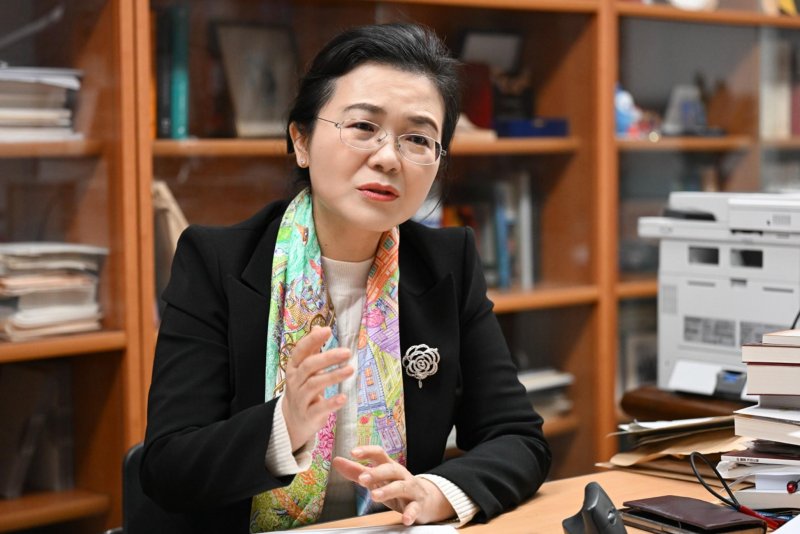
UPDATE: A prominent law professor from Korea University has raised urgent concerns regarding a series of judicial reform bills proposed by South Korea’s ruling party, warning that they could significantly undermine judicial independence. Cha Jin-ah, a constitutional law expert and former constitutional researcher at the Constitutional Court, stated, “unchecked power leads to dictatorship,” during an interview conducted earlier today.
The proposed reforms include expanding the number of Supreme Court justices, creating a new appellate court, and establishing a special court for treason. Cha emphasizes that while she supports some reforms, the push to process multiple bills simultaneously raises red flags about the ruling party’s intent. She cautioned that such changes could lead to a dangerous consolidation of power.
Officials have indicated that increasing the number of Supreme Court justices from the current count is necessary for improved judicial function. However, Cha argues that a proposed increase by up to 12 justices would effectively double the court’s size, leading to blatant political appointments. “Adding about one division—meaning four justices—is appropriate,” she noted, warning that larger increases could compromise judicial integrity.
Moreover, Cha criticized the proposed court petition system, calling it overly simplistic. She questioned how the Constitutional Court could manage a flood of petitions if all final judgments alleged to violate due process were subject to review. “Can the Constitutional Court handle that?” she asked, highlighting the potential for overwhelming the system.
The ruling party’s plans also include revising controversial elements such as a special court for treason and a new crime of “distorting the law.” Cha expressed skepticism about the motives behind these proposals, suggesting they may be designed to manipulate treason trials and suppress political opposition. She labeled the concept of a special court for treason as unconstitutional and warned that it could erode the foundation of fair trials.
In her remarks, she stated, “The crime of distorting the law is barbaric,” comparing it to a clause in Germany that punishes judges from the Nazi era. Cha fears that similar legislation in South Korea could lead to abuse, where officials may feel pressured to conform to political authorities to avoid criminal charges.
Cha also criticized plans to abolish the court administration office and create a judicial administration committee, asserting that removing judicial administrative authority from the courts violates constitutional principles. “Judicial power includes not only adjudication but judicial administration,” she affirmed.
As these reform bills gain traction, Cha stressed that public opinion could play a crucial role in checking the ruling party’s agenda. “Democracy does not operate only on election day. The people must control the power they entrust,” she urged, emphasizing the importance of active civic engagement.
The debate surrounding these proposed reforms is intensifying as the ruling party seeks to push through legislation in the coming weeks. With December 17, 2023, marking a crucial date for discussions, the implications of these reforms could profoundly affect the balance of power in South Korea’s judicial system.
As the situation develops, observers are closely monitoring how public sentiment and opposition responses will impact the legislative process. South Korea stands at a critical juncture, and the outcome of these reforms will shape the nation’s democratic principles for years to come.