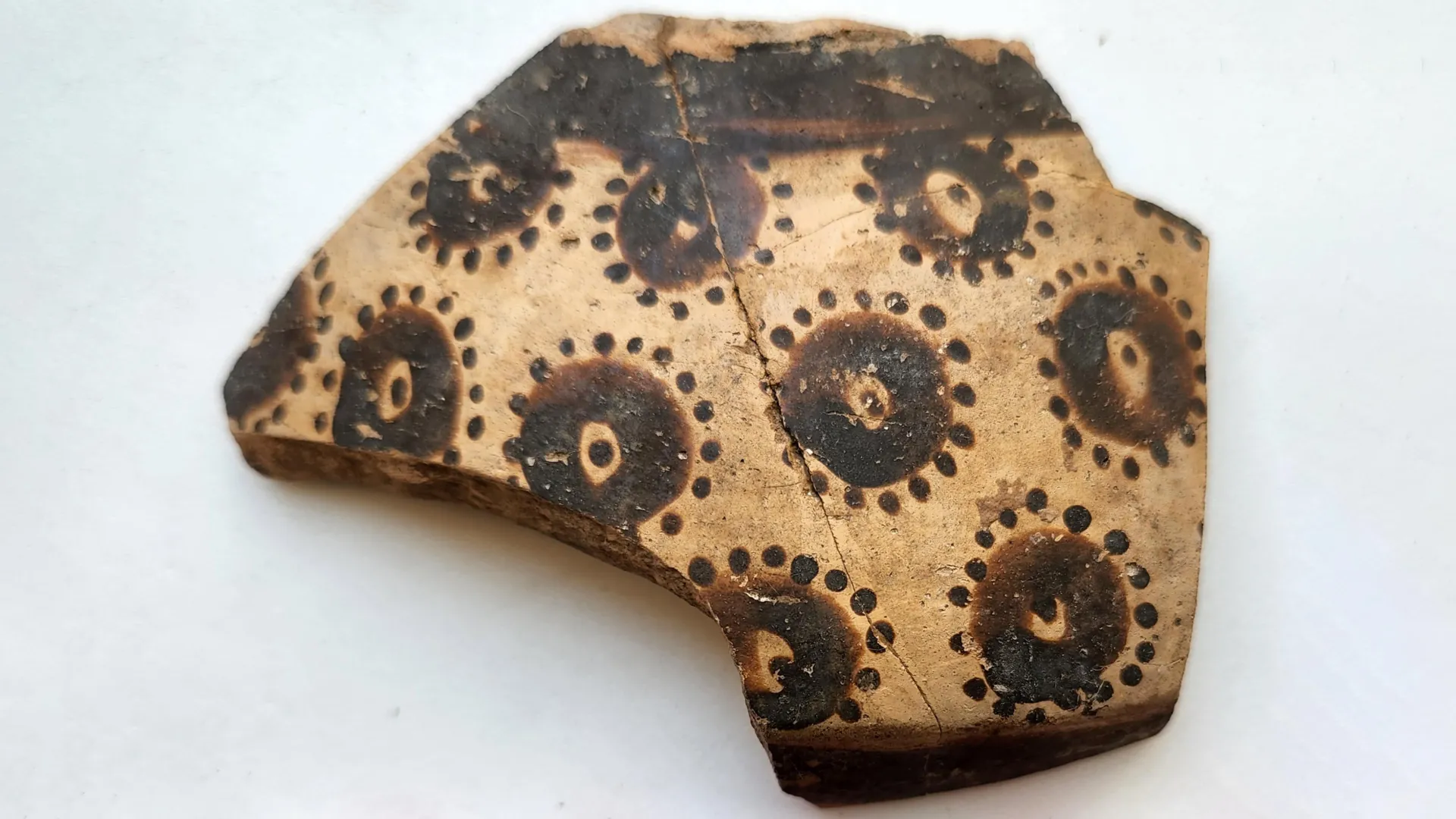
Early farming communities in northern Mesopotamia demonstrated advanced mathematical thinking over 8,000 years ago, well before the invention of written numbers. Researchers at the Hebrew University of Jerusalem studied Halafian pottery and discovered intricate floral designs that reveal a sophisticated understanding of geometry and numerical patterns.
A study published in the Journal of World Prehistory highlights that the earliest known artistic representations of plants served a purpose beyond mere decoration. By analyzing prehistoric pottery, Prof. Yosef Garfinkel and Sarah Krulwich traced the use of plant imagery back to the Halafian culture, which thrived between 6200 and 5500 BCE. Their findings indicate that early artisans crafted flowers, shrubs, branches, and trees with deliberate geometric structures and numerical arrangements.
Botanical Imagery Transforms Prehistoric Art
Prior to the Halafian period, prehistoric artists primarily depicted animals and human figures. The introduction of plant motifs on pottery marks a significant shift in artistic focus, reflecting evolving cultural values. Researchers examined artifacts from 29 archaeological sites, documenting hundreds of plant designs. While some images were realistic, others were more abstract, yet all displayed intentional design rather than random decoration.
“These vessels represent the first moment in history when people chose to portray the botanical world as a subject worthy of artistic attention,” the authors state. This artistic transition aligns with a cognitive shift associated with village life, highlighting a growing awareness of symmetry and aesthetics.
Unveiling Hidden Mathematical Patterns
Among the most intriguing discoveries was the arrangement of floral patterns on the pottery. Many pieces showcase petal counts that follow distinct numerical sequences, such as 4, 8, 16, 32, and even 64 flowers. The researchers argue that these arrangements suggest a planned approach to design, indicating an advanced comprehension of spatial division.
“The ability to divide space evenly, reflected in these floral motifs, likely had practical roots in daily life, such as sharing harvests or allocating communal fields,” Garfinkel explains. This research enriches the field of ethnomathematics, which investigates how mathematical ideas manifest in cultural practices and artistic expressions.
The pottery designs feature a diverse array of plant forms, yet notably absent are images of edible plants. This omission suggests that the designs were not intended to document agricultural practices or rituals. Instead, the emphasis on flowers may relate to their emotional resonance, making them appealing subjects for artistic representation.
The Halafian pottery provides fresh perspectives on the origins of mathematical thought. Although written records of mathematics appeared later in Sumer, the findings indicate an earlier, more intuitive form of mathematical reasoning, grounded in visual organization rather than written symbols.
“These patterns show that mathematical thinking began long before writing,” Krulwich asserts. “People visualized divisions, sequences, and balance through their art.” By systematically documenting these botanical designs and uncovering their mathematical structure, the study offers valuable insights into how early societies perceived their environment and demonstrated complex cognitive abilities long before formal mathematics emerged.
This research not only illuminates the artistic and mathematical legacy of ancient cultures but also invites a reevaluation of how we understand the development of human thought and creativity.