New research has shown that the ancient settlement of Jiahu, located in Henan Province, China, not only endured the abrupt climatic challenges of the 8.2 ka event but also demonstrated significant social transformation during this period. Led by Dr. Yuchen Tan and colleagues, the study published in the journal Quaternary Environments and Humans challenges the prevailing notion that this climate event was solely catastrophic for all communities in the North China Plain.
Understanding the 8.2 ka Event
The 8.2 ka event was a brief but intense climate shift that occurred approximately 8,200 years ago, primarily identified through data from Greenland ice cores. This period was characterized by substantial cooling and drying across the Northern Hemisphere, triggered by the collapse of the Laurentide ice sheet. The resulting influx of freshwater into the North Atlantic weakened the Atlantic Meridional Overturning Circulation and shifted the Intertropical Convergence Zone southward. As a consequence, areas dependent on the East Asian Summer Monsoon, including the North China Plain, experienced significant climate disruptions, leading many settlements to abandon their locations.
Contrary to this trend, Jiahu not only survived but also thrived, prompting researchers to investigate the factors behind its resilience. The study employed resilience theory alongside the Baseline Resilience Indicator for Communities (BRIC) model, which traditionally assesses how modern communities respond to natural disasters.
Transformations at Jiahu
To understand how Jiahu adapted during the 8.2 ka event, researchers analyzed archaeological evidence from three distinct phases of occupation: Phase I (9.0–8.5 ka BP), Phase II (8.5–8.0 ka BP), and Phase III (8.0–7.5 ka BP). Notably, Phase II coincided directly with the climatic event and revealed substantial social changes. The number of burials more than doubled, from 88 in Phase I to 206 in Phase II. This increase is indicative of both heightened mortality and an influx of migrants from surrounding areas.
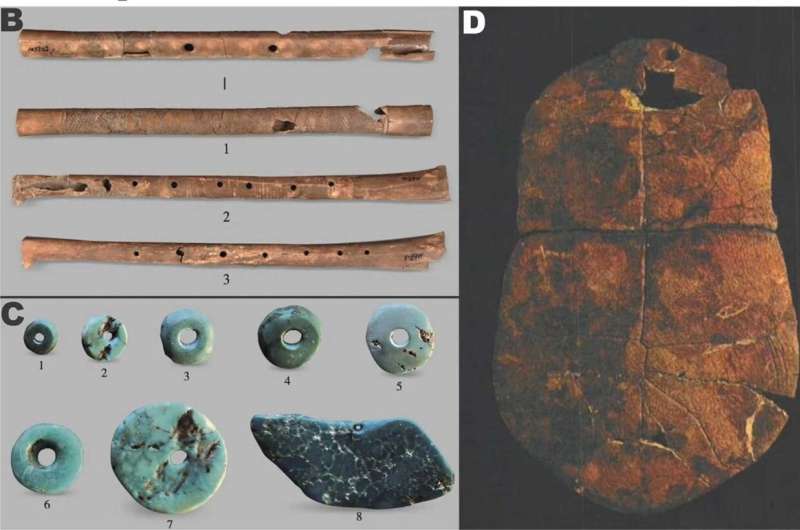
The study also noted a shift in burial practices, with an increase in grave goods, which may reflect growing wealth disparities and the emergence of social stratification. Analysis of skeletal remains suggested a more defined division of labor, particularly with males exhibiting higher rates of osteoarthritis, implying increased physical labor demands.
These demographic and social shifts appear to have bolstered Jiahu’s workforce, enhancing its ability to secure food and manage the difficulties imposed by the 8.2 ka event. By Phase III, however, the number of burials decreased to 182, and grave goods became less common, suggesting a reorganization and innovation response to the changing environment.
Dr. Tan emphasized that the ultimate decline of Jiahu was not directly tied to the 8.2 ka event itself but rather to subsequent climatic fluctuations that caused severe flooding, rendering the settlement unsustainable. “After Phase III, the Jiahu settlement faced frequent climatic fluctuations, which further triggered flooding and finally led to the decline of the Jiahu culture,” Dr. Tan stated.
This research illustrates that ancient communities were capable of remarkable adaptation during significant climate challenges. The application of the BRIC model to archaeological contexts presents a new framework for understanding how human systems reorganize in response to abrupt environmental changes, offering valuable insights into resilience across time and space.
As the study highlights, the narrative surrounding the 8.2 ka event and its impact on human societies is far more complex than previously thought. Jiahu stands as a testament to human resilience and adaptability in the face of climatic adversity.