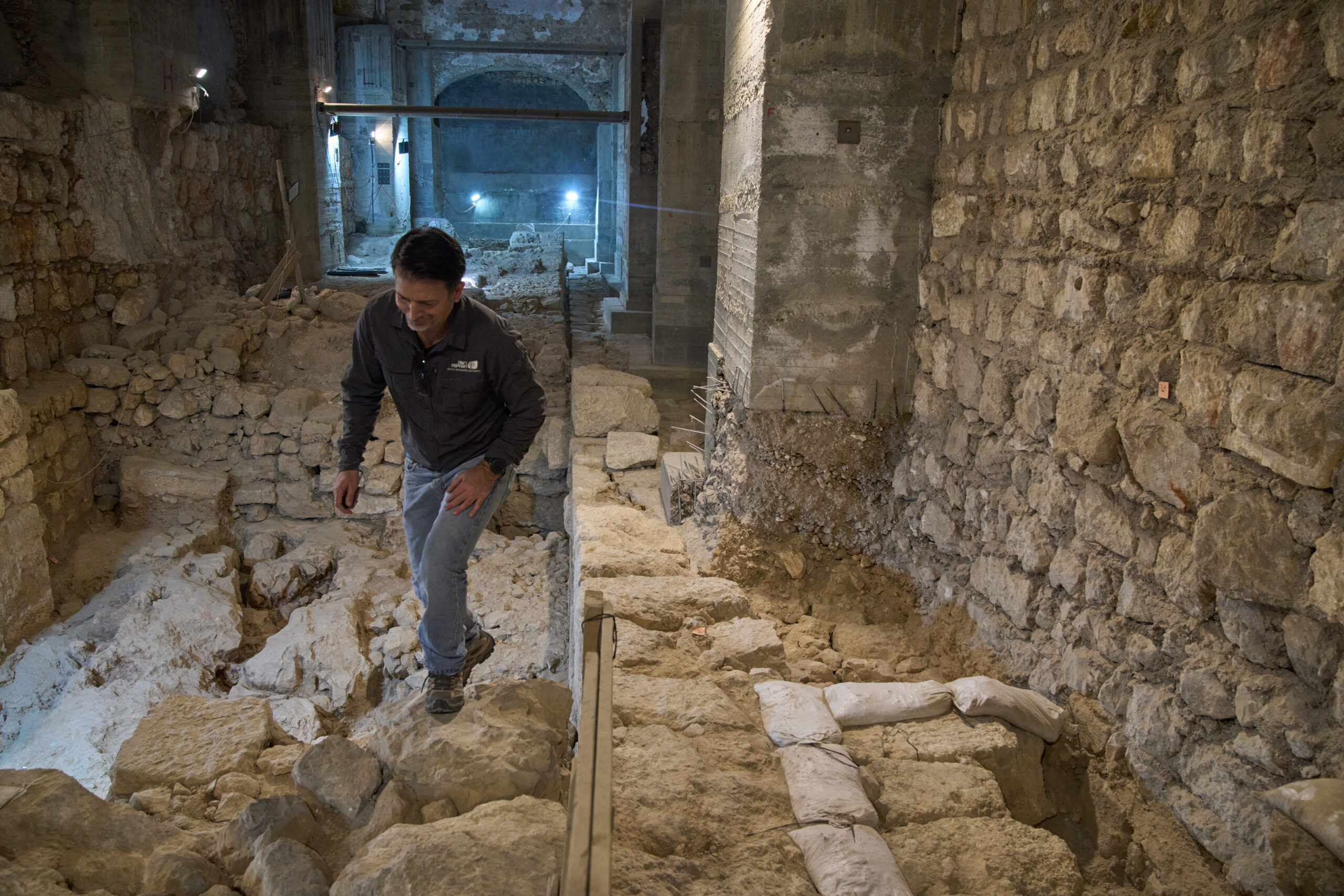
Archaeologists in Jerusalem have uncovered a significant section of the ancient wall that once encircled the city, dating back to the time of the Hasmonean Kingdom. This discovery, which includes potential evidence of a ceasefire from approximately 2,100 years ago, marks the completion of the longest continuous remnants of the wall ever found.
The excavation was finalized last week, revealing an impressive section of the wall’s foundation. This wall, built shortly after the events commemorated during Hanukkah, spans nearly 50 meters (164 feet) in length and 5 meters (16 feet) in width. It is believed to have originally supported walls taller than those currently surrounding the Old City of Jerusalem, which predominantly date back to the Ottoman Era.
Historical Context and Significance
The Hasmonean walls encompassed an area significantly larger than today’s Old City, featuring around 60 watchtowers that exceeded 10 meters (33 feet) in height, according to ancient texts. Dr. Amit Re’em, a leading archaeologist from the Israel Antiquities Authority, highlighted a particularly intriguing aspect of the excavation: the wall appears to have been intentionally dismantled to a uniform height rather than experiencing chaotic destruction from conflict or time.
This raises questions about the motivations behind dismantling such a critical security structure. Historical accounts by the ancient Jewish historian Flavius Josephus indicate that during the siege of Jerusalem by Hellenistic King Antiochus VII around 132 B.C., a ceasefire agreement was reached with Jewish King John Hyrcanus I. According to Josephus, Hyrcanus was compelled to dismantle the Hasmonean fortifications in exchange for the withdrawal of Antiochus’ forces.
“Antiochus Sidetes reached a ceasefire agreement with John Hyrcanus, saying, if you want me to remove my army, you yourself, the Jewish king, must raze to the ground the Hasmonean fortification that you and your father built,” Dr. Re’em stated. This archaeological evidence appears to support Josephus’ narrative, creating a fascinating intersection of history and archaeology.
Future Developments and Continued Research
Another theory posited by Dr. Re’em suggests that the foundations of the Hasmonean wall may have been repurposed by King Herod during the first century B.C. when he constructed his palace, thereby asserting his dominance over Jerusalem. Orit Peleg-Barkat, head of classical archaeology at the Hebrew University of Jerusalem, speculated that the dismantling may have been related to Herod’s construction activities rather than the ceasefire with Antiochus. This is supported by the fact that other sections of the Hasmonean wall remain intact.
The recently uncovered wall section lies beneath an abandoned wing of the Kishleh, a military base established in 1830. This wing served various purposes, including as a prison used by the British until the 1940s, with visible remnants of iron bars still present. The excavation began in 1999 but was interrupted due to violence during the Second Intifada, resuming only two years ago.
Over the past two years, archaeologists have excavated the equivalent of two Olympic swimming pools worth of soil and debris. The findings also include dye pits believed to date back to the Middle Ages, alongside the significant section of the Hasmonean wall foundation.
Plans for the future include the installation of a floating glass floor over the ruins by the Tower of David Museum, transforming the space into a new gallery within the Schulich Wing of Archaeology, Art and Innovation. Renovations are expected to take at least two years following the conclusion of the archaeological work, offering visitors a unique glimpse into Jerusalem’s rich historical tapestry.