Researchers at **National Taiwan University** have made a significant breakthrough in understanding the exceptional ability of copper chalcogenides to convert carbon dioxide (CO2) into formate. Published on **December 3, 2025**, in the journal **Nature Communications**, the study reveals a charge-redistribution mechanism that explains why these materials exhibit such selective conversion, a characteristic typically associated with p-block metals like tin or bismuth.
For years, scientists have been intrigued by the capacity of copper chalcogenides to achieve high selectivity in the CO2 reduction process. This selectivity stands out particularly for **copper (Cu)**, which usually shows little intrinsic product preference. Despite extensive research, the origins of this unique behavior remained largely unexplained until now.
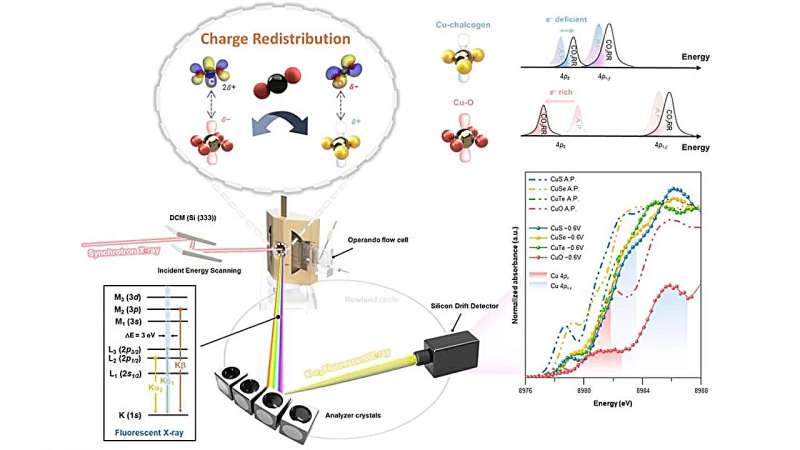
The research team utilized advanced operando synchrotron-based X-ray spectroscopic techniques to capture direct evidence of the mechanisms at play. Their findings indicate that chalcogenide anions play a crucial role. They stabilize the catalytic structure, preventing the over-reduction of cuprous (Cu+) species to metallic copper (Cu0). This stabilization maintains an electronic configuration that favors mono-carbon intermediates such as carbon monoxide (CO) and formate.
Furthermore, the study highlights a charge-redistribution process within the Cu+ sites. This dynamic stabilization enhances the formation of O-bound formate intermediates, effectively steering the reduction pathway toward formate production while suppressing competing reactions that lead to CO and multi-carbon products. Consequently, Cu-chalcogenide catalysts achieve near-total selectivity for formate.
In their experiments, the optimal **CuS** catalyst demonstrated an impressive **90% faradaic efficiency** for formate production at **−0.6 V**, with a formate partial current exceeding an ampere-scale. These results suggest scalability for potential industrial applications, paving the way for more efficient CO2 conversion technologies.
Hao Ming Chen, a distinguished professor of chemistry and co-corresponding author of the study, emphasized the importance of this work: “Copper chalcogenides have fascinated researchers for decades because of their enhanced formate selectivity, but the true origin of this behavior was never fully understood. Our study reveals that charge-redistribution dynamics redefine the fundamental principles governing CO2 reduction selectivity and offer a new design strategy for tuning catalyst electronic structure via chalcogen modification.”
This research marks a pivotal advancement in the field of electrocatalysis, offering foundational insights that could influence the future design of catalysts for CO2 reduction. By understanding and manipulating charge redistribution dynamics, scientists can explore new avenues to enhance selectivity and efficiency in catalytic processes.
As the world continues to seek sustainable solutions to combat climate change, findings like these offer hope for developing technologies that can effectively convert carbon emissions into useful chemicals, contributing to a more sustainable future.